
Creating Purchase Order Response (EDI ORDRSP)
The Purchase Order Response (EDI ORDRSP) is a transaction sent by a supplier to a buyer to confirm receipt of a Purchase Order (EDI ORDERS) and state whether the order is accepted, rejected, or accepted with changes (such as different quantities, prices, or delivery dates).
This guide walks you through the steps of creating an EDI ORDRSP in the EDI Generator, with a focus on creating one from scratch using GS1 EANCOM 2002 S4 (D.01B, EANCOM subset version 009) ORDRSP specification, edition 2016.
Creating an EDI ORDRSP from Scratch
If you need to initiate a Purchase Order Response creation, follow these steps using our sample scenario.
Scenario Context
- Partner: IKEA
- Order Response Number:
ORSP-778812 - Response Date:
2026-09-02(current date) - PO Number:
1252448667 - PO Date:
2026-09-01 - Supplier Order Number:
SO-4471209 - Department Number:
00054 - Buyer (IKEA): GLN
7318280010002, VAT numberBE0417352939 - Supplier (you): GLN
5412345500001, VAT numberNL812345678B01, vendor number412556789 - Currency:
EUR - Current Scheduled Ship Date:
2026-09-10 - Response: the order is accepted with changes —
- Line 1: GTIN
7318280450129, buyer itemIK-40234501,100EA at15.50— accepted as ordered - Line 2: GTIN
7318280450235, buyer itemIK-70234502,60EA ordered at22.00— only40available now,20on backorder for2026-09-24 - Line 3: GTIN
7318280450334, buyer itemIK-90234503,25EA ordered — rejected, item discontinued
- Line 1: GTIN
Start Response Creation
- In the side menu, navigate to ORDRSP (or Outgoing Types > ORDRSP Purchase Order Response Message if nested).
- Click the Create button in the top-right corner.
- Select your partner (e.g., IKEA) from the dropdown.
- The EDI editor will load the structure for the ORDRSP document.
For a detailed guide on how the EDI Editor interface works (including how to add segment iterations, use Basic or Advanced loop modes, and locate validation errors), see Create New EDI File.
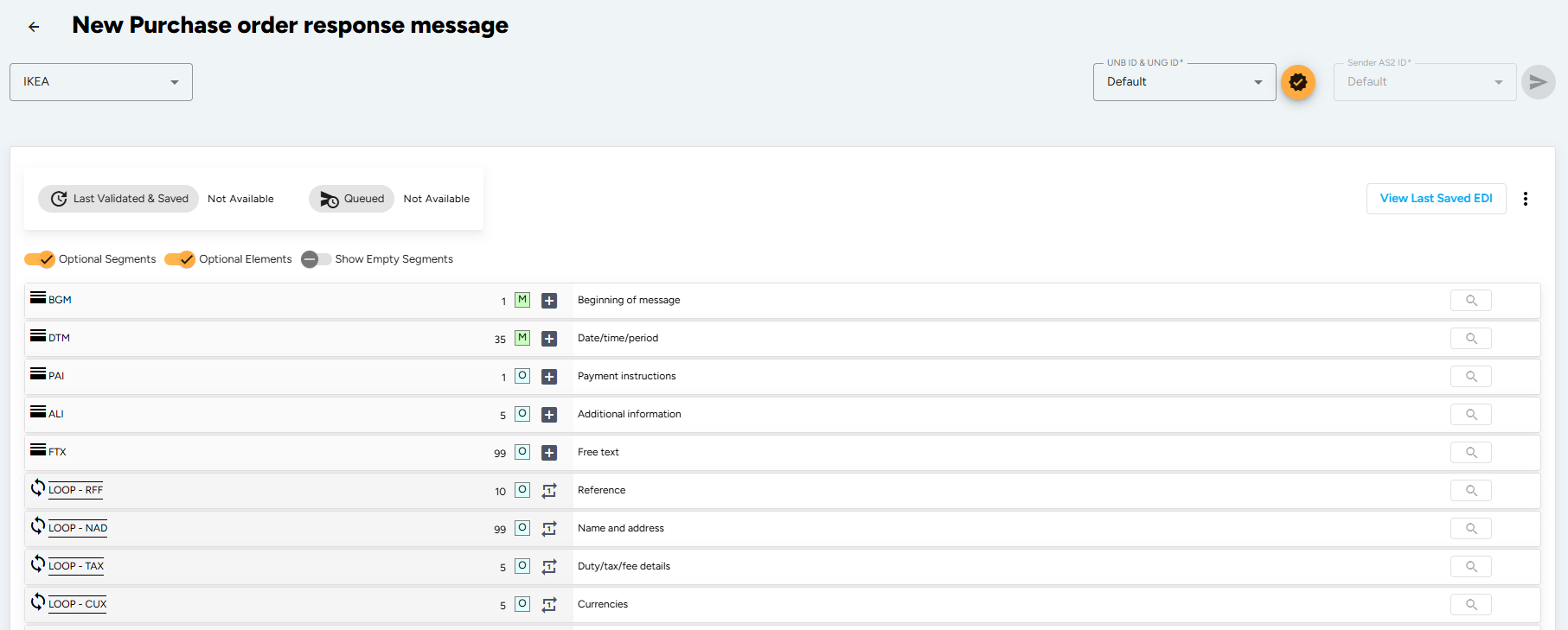
The UNA, UNB and UNH service segments (service string advice, interchange header and message header) are generated automatically by the EDI Generator from the partner profile you selected. You only fill in the segments described below, starting at BGM.
Enter Beginning Segment details (BGM Segment)
The BGM segment carries the response number and — critically — the overall response status of the whole message. Click on the BGM segment row in the editor to open its fields:
- Document/message Name, Coded (BGM010-01): Enter
231(Purchase order response). - Document/message Number (BGM020-01): Enter your own order response number (e.g.
ORSP-778812). Note that unlike X12, the buyer’s PO number is not carried here — all other references go in the RFF segment. - Message Function Code (BGM030): Select the response status. This is the critical element in this segment:
29– Accepted without amendment (the whole order is accepted as-is).4– Change (accepted, but one or more lines require changes).27– Not accepted (the whole order is declined).45– Accepted with reserves (a provisional response; confirm later with a new ORDRSP).12– Not processed (order received but not yet processed).
- Response Type, Coded (BGM040): Optional — enter
AC(Acknowledge with detail and change),AI(Acknowledge only changes) orNA(No acknowledgement needed) if you want to state explicitly whether a reply is expected.
Enter Response Date (DTM Segment)
The DTM segment specifies the date of the response. Identification of the document/message date (qualifier 137) is mandatory in every EANCOM message.
- Date/time/period Qualifier (DTM010-01): Enter
137(Document/message date/time). - Date/time/period (DTM010-02): Current Date in the format CCYYMMDD.
- Date/time/period Format Qualifier (DTM010-03): Enter
102to specify the format you used as CCYYMMDD.
Add iterations with qualifier 11 (Dispatch date), 76 (Delivery date scheduled for) or 69 (Delivery date promised for) if applicable.
Add Message Level Free Text (FTX Segment - Optional)
The FTX segment is for narrative information that applies to the whole response, such as a note explaining a partial acceptance.
- Text Subject Qualifier (FTX010): Enter
PUR(Purchasing information) orZZZ(Mutually defined). - Text Reference (FTX030-01): Enter a mutually agreed standard text code, plus
91(Assigned by supplier) or92(Assigned by buyer) in Free Text, Coded (FTX030-03). - Free Text (FTX040-01): Enter the clear text, only when a coded text cannot be used.
- Language, Coded (FTX050): Enter the ISO 639 two-alpha code when clear text is used.
GS1 does not recommend free-form text, since it prevents automatic processing. Where possible use a coded standard text agreed with the partner.
Reference the Purchase Order Being Answered (RFF Loop)
The RFF loop is where the order you are responding to is identified, and it is the only place the buyer’s PO number appears. Each reference may be followed by its own DTM segment.
- Buyer’s Order Number (first iteration):
- Reference Qualifier (RFF010-01): Enter
ON(Order number - buyer). - Reference Number (RFF010-02): Enter the buyer’s PO number (e.g.
1252448667). - DTM: Enter qualifier
171(Reference date/time), the PO date and format102.
- Reference Qualifier (RFF010-01): Enter
- Supplier’s Order Number (add another iteration, optional):
- Reference Qualifier (RFF010-01): Enter
VN(Order number - supplier) and your own sales order number in RFF010-02.
- Reference Qualifier (RFF010-01): Enter
- Other useful qualifiers here are
CT(Contract number),BO(Blanket order number),PW(Prior purchase order number),PD(Promotion deal number) andCR(Customer reference number).
Configure Party Details (NAD Loop)
The NAD Loop is used to identify the trading partners involved in the Purchase Order Response. Identification of the Buyer (BY) and the Supplier (SU) is mandatory in an ORDRSP. Where a GLN is available, parties are identified in coded form only — the clear-text name and address composites (NAD040 party name through NAD090 country) are used only when a coded identification cannot be used.
- Click the NAD Loop to expand it.
- Buyer (BY):
- Party Qualifier (NAD010): Select
BY(Buyer). - Party Id. Identification (NAD020-01): Enter the 13-digit GLN of the buying entity.
- Code List Responsible Agency (NAD020-03): Select
9(GS1).
- Party Qualifier (NAD010): Select
- Supplier (SU):
- Click Add Loop Iteration to add a second NAD entry.
- Party Qualifier (NAD010): Select
SU(Supplier). - Party Id. Identification (NAD020-01): Enter your own 13-digit GLN.
- Code List Responsible Agency, Coded (NAD020-03): Select
9(GS1).
- Other qualifiers available are
DP(Delivery party),IV(Invoicee),SN(Store number),WH(Warehouse keeper) andUD(Ultimate customer). Only add these as a clarification or correction to the received order — the delivery address given in NAD at header level is the main delivery address for all line items.
Add Party References (RFF Loop under NAD)
The RFF segment nested inside the NAD loop carries references that belong to that party only.
- Expand the RFF row under the Buyer (BY) NAD iteration:
- Reference Qualifier (RFF010-01): Enter
VA(VAT registration number). - Reference Number (RFF010-02): Enter the buyer’s VAT registration number.
- Add another iteration with
CR(Customer reference number) for the buyer’s department number.
- Reference Qualifier (RFF010-01): Enter
- Under the Supplier (SU) NAD iteration, add your own
VAVAT registration number and — if the buyer assigns you one — your vendor number with qualifierIA(Internal vendor number). - Other qualifiers available here are
FC(Fiscal number),TL(Tax exemption licence number),GN(Government reference number) andIT(Internal customer number).
Specify the Currency (CUX Segment)
The CUX segment states the currency of the response and is mandatory for international exchanges.
- Currency Details Qualifier (CUX010-01): Enter
2(Reference currency). - Currency, Coded (CUX010-02): Enter the ISO 4217 three-alpha code (e.g.
EUR). - Currency Qualifier (CUX010-03): Enter
4(Invoicing currency).
Configure Line Items (LIN Loop)
The LIN Loop is used to identify the products in question.
- Line Item (LIN):
- Line Item Number (LIN010): Enter a sequential line number starting at
1. - Action Request/notification, Coded (LIN020): Select the status for this item. This is the critical element in this segment:
5– Accepted without amendment. Re-transmitting unamended lines is optional but common for confirmation.3– Changed. The line is accepted, but you require changes — quantity, date or price.7– Not accepted. You decline to supply the line.1– Added. Used when you split one ordered line into two response lines; both must refer to the same order and line number.4– No action. The line has not been processed yet.
- Item Number (LIN030-01): Enter the GTIN of the article. Where a GTIN exists, its use in LIN is mandatory.
- Item Number Type, Coded (LIN030-02): Enter
SRV(GS1 Global Trade Item Number).
- Line Item Number (LIN010): Enter a sequential line number starting at
- Quantity (QTY Segment): Add one iteration per quantity type.
- Quantity Qualifier (QTY010-01):
21– Ordered quantity (what the buyer asked for; always send this).113– Quantity to be delivered (what you are committing to).83– Backorder quantity (the shortfall you will supply later).12– Dispatch quantity.
- Quantity (QTY010-02): Enter the quantity.
- Measurement Unit Qualifier (QTY010-03): Only used for variable-quantity products, e.g.
KGM.
- Quantity Qualifier (QTY010-01):
- Line Item Amount (MOA Segment):
- Monetary Amount Type Qualifier (MOA010-01): Enter
203(Line item amount). - Monetary Amount (MOA010-02): Enter the net value of the line.
- Monetary Amount Type Qualifier (MOA010-01): Enter
- Price Details (PRI Segment):
- Price Qualifier (PRI010-01): Enter
AAA(Calculation net). In an ORDRSP the calculation price is always the net unit price, i.e. gross price + charges − allowances. - Price (PRI010-02): Enter the unit price, e.g.
15.50. - Price Type, Coded (PRI010-03): Enter
CT(Contract) orCA(Catalogue).
- Price Qualifier (PRI010-01): Enter
- Line Level References (RFF Loop): use this to tie your response line back to the exact line on the buyer’s order — it is what lets the buyer reconcile a split or renumbered response.
- Reference Qualifier (RFF010-01): Enter
ON(Order number - buyer). - Reference Number (RFF010-02): Enter the buyer’s PO number.
- Line Number (RFF010-03): Enter the line number from the original order.
- Reference Qualifier (RFF010-01): Enter
Set Transaction Totals (UNS, MOA and CNT Segments)
The UNS segment marks the break between the detail and summary sections.
- Section Identification (UNS010): Enter
S(Detail/summary section separation). - Monetary Amount (MOA) — the total value of the response:
- Monetary Amount Type Qualifier (MOA010-01): Enter
79(Total line items amount). Other qualifiers are86(Message total monetary amount),176(Message total duty/tax/fee amount),259(Total charges) and260(Total allowances). - Monetary Amount (MOA010-02): Total monetary amount.
- Monetary Amount Type Qualifier (MOA010-01): Enter
- Control Total (CNT):
- Control Qualifier (CNT010-01): Enter
2(Number of line items in message). Use1for the total of line-level quantities (theCTT02hash total equivalent),7for total gross weight or29for total net weight. - Control Value (CNT010-02): Enter the relevant value depending on the qualifier.
- Control Qualifier (CNT010-01): Enter
The segments and element rules detailed above represent a sample IKEA ORDRSP specification scenario. Depending on your partner, the required qualifiers, loops, pattern validations, and mandatory elements can vary. The EDI Generator automatically aligns the editor form fields and validation rules to match whichever partner definition you select.
Validate, Save, and Send
- Once all details are filled, click the Validate and Save button in the top-right corner.
- The EDI Generator will check your document against the EANCOM 2002 S4 syntax rules and the validation rules defined in the IKEA ORDRSP specification, including segment group cardinality, mandatory data elements, and the control totals in CNT etc.
- If there are validation errors, correct the pointed out segments and re-validate.
- Once the validation is successful, click Send to transmit the ORDRSP Purchase Order Response to IKEA over AS2/SFTP.
Once you acknowledge the order, the next step in the cycle is packing the goods and generating the shipping documents. See Creating Dispatch Advices (EDI DESADV) for instructions on the shipment notice, and Creating Invoices (EDI INVOIC) for requesting payment.