





![Open-Source Transfer vs Managed File Transfer [Updated 2026]](/assets/images/blog/open-source-transfer-vs-managed-file-transfer.png)







Hosted SaaS solution for AS2 and SFTP file transfer. No infrastructure, instant setup.
Start Free Trial
EDI 864 carries free-form text between trading partners, alerts, instructions, compliance notes. Learn when to send one and how it fits in X12 EDI.

Akila Ishani
Published: 19 May 2026

EDI 864 is the X12 “Text Message” transaction set, a standard way for trading partners to exchange free-form, human-readable notes inside an EDI workflow. Unlike the 850 or 856, the 864 isn’t structured for automated processing. Teams use it for notifications, compliance notes, error explanations, and clarifications that don’t fit any other transaction code, while still keeping the message inside the same audited AS2 or VAN channel as the rest of their EDI traffic.
Most EDI traffic is rigidly structured, every byte in an 850 purchase order or 856 ASN has its slot. But sometimes you need to send a partner a note: a compliance alert, an exception explanation, a contract clarification. That’s what EDI 864 is for. This guide covers what the EDI 864 text message transaction does, what’s inside one, and when it’s the right code to send.
Within the X12 EDI standard, transaction sets define the structure and content of data exchanged for specific business purposes. Each transaction set is identified by a unique number and name and is maintained by specialized subcommittees within the X12 Accredited Standards Committee. While each subcommittee manages certain transaction sets, all are available for use across industries.
EDI companies and solution providers leverage these standardized transaction sets to ensure consistent, reliable, and interoperable data exchange between trading partners.
Read more: Types of EDI
If your business uses Electronic Data Interchange (EDI), you’ll encounter a variety of codes that represent documents such as purchase orders, invoices, and shipping notices exchanged electronically between trading partners. However, these codes aren’t universal; different industries rely on specific EDI documents tailored to support their unique day-to-day operations.
The EDI 864, commonly known as the “Text Message” transaction, is designed for sharing free-form, human-readable information between trading partners. Unlike most EDI documents, which are highly structured for automated processing, the 864 allows businesses to communicate messages that require interpretation by people rather than EDI systems.

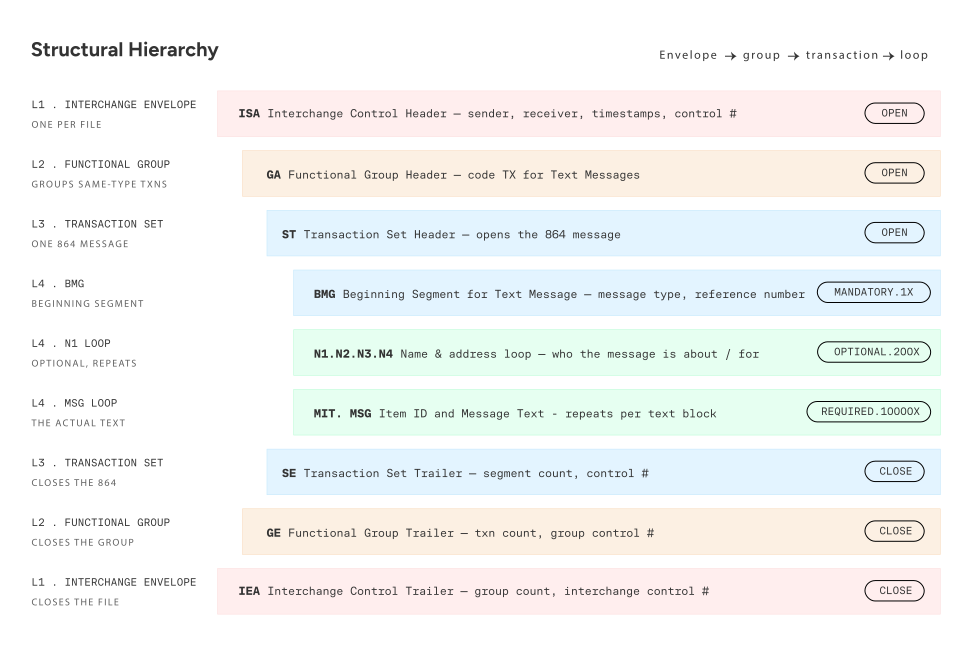

The EDI 864 is especially useful when businesses need to communicate information that doesn’t fit into structured EDI formats. Common use cases include:
While most EDI transactions are built for automation, real-world business communication often requires flexibility. The EDI 864 fills this gap by enabling clear, direct messaging between partners without abandoning the EDI framework. It ensures that important information is delivered reliably, even when it can’t be easily standardized.
Read more: EDI Document Types Explained: 850, 810, 856, & More
Not all EDI platforms offer the same capabilities, especially when it comes to handling flexible transactions like the EDI 864. To manage text-based communications effectively, businesses need a solution that goes beyond basic data exchange, one that supports unstructured messaging, integrates seamlessly with existing systems, and ensures consistent, reliable EDI communication with trading partners.
When evaluating EDI software, it’s important to look at several key factors:
At Aayu Technologies, we built the EDI Generator specifically because we kept seeing that choosing the right EDI solution isn’t just about meeting current needs; it’s about building an EDI communication infrastructure that can adapt as your business and partner ecosystem evolve.

Experience all-in-one cloud-based EDI solution from EDI file processing to AS2 file transfer.
Sign up for the 30-day free trial and evaluate EDI as a service with no restrictions. No credit card required.
Q1: What does EDI 864 stand for? EDI 864 is the X12 “Text Message” transaction set, one of the standardized document types maintained by the X12 Accredited Standards Committee. It carries free-form, human-readable text between trading partners. It’s one of the few EDI documents not designed for automated processing; the message is meant for a person on the receiving end.
Q2: When should I use EDI 864 instead of email? Use EDI 864 when the message needs to travel through the same audit trail, security envelope, and partner connection as the rest of your EDI documents. Compliance notices, error explanations tied to a specific 850 or 856, and supply-chain instructions are typical examples. Email is fine for ad-hoc people-to-people notes; EDI 864 is for partner-to-partner messages inside your B2B integration channel.
Q3: Is EDI 864 still used in 2026? Yes. Retailers, 3PLs, and pharma trading partners still use EDI 864 for notifications and clarifications that flow through their AS2 or VAN connection. It’s less common than the 850/856/810 cluster but remains active wherever partners want a single, audited communication channel rather than out-of-band email.
Q4: What’s the difference between EDI 864 and EDI 997? The 997 Functional Acknowledgment confirms whether a received EDI document was structurally valid, it’s automated and machine-read. The 864 carries a free-form text message and doesn’t acknowledge anything by itself. Think of it this way: 997 is the receipt, 864 is the note attached to it.
Q5: How do I send an EDI 864 with my EDI software? With a cloud EDI platform like Aayu’s EDI Generator, you compose the 864 inside the tool, route it through your AS2 (or SFTP/VAN) connection to the trading partner, and store the MDN for audit. The platform builds the X12 envelope segments, version, and message identifiers automatically, no manual mapping needed.
Join hundreds of organizations already taking full control of their B2B AS2 communications with our trusted solutions. Contact us today to tailor a solution that fits your specific AS2 EDI needs.
Get full access to whichever product fits your needs. Configure real trading partner connections, run end-to-end transactions, and see the platform perform before making any commitment. All three products include a free 30-day trial with no restrictions.