






![Open-Source Transfer vs Managed File Transfer [Updated 2026]](/assets/images/blog/open-source-transfer-vs-managed-file-transfer.png)





Hosted SaaS solution for AS2 and SFTP file transfer. No infrastructure, instant setup.
Start Free Trial
Deploy AS4 software in healthcare for EUDAMED M2M, eHDSI, and MDR compliance. Best practices for WS-Security, X.509 certificates, retries, and signed receipts.

Adeesha Jayasinghe
Published: 08 May 2026

The landscape of healthcare data exchange has evolved significantly due to increasing regulatory requirements and the growing need for seamless cross-border interoperability. As the industry moves toward the mid-2020s, the Applicability Statement 4 (AS4) protocol has emerged as the definitive standard for secure, reliable, and payload-agnostic business-to-business (B2B) and business-to-government (B2G) communication. This article examines the architectural foundations of AS4, details the best practices for its deployment in the healthcare domain, and highlights how advanced platforms such as the Aayu Technologies MFT Gateway facilitate mission-critical connectivity to systems like the European Database on Medical Devices (EUDAMED).
Readmore on AS4 e-delivery use cases on EU.
For over two decades, the healthcare sector relied heavily on the Applicability Statement 2 (AS2) protocol for electronic data interchange (EDI). While AS2 provided a foundational layer for secure document transfer using HTTP and S/MIME, it was increasingly constrained by its document-centric design and limited support for modern web services. The transition to AS4 represents a fundamental shift towards a service-oriented architecture (SOA) that aligns with cloud-native environments and modern API-driven healthcare ecosystems.
AS4 is a subset of the ebMS 3.0 (electronic business Messaging Service) specification, designed to offer a “just-enough” messaging standard that minimizes complexity while maximizing security and reliability. In contrast to its predecessor, AS4 utilizes SOAP (Simple Object Access Protocol) and the WS-Security suite, providing a more extensible and flexible framework for authentication, encryption, and non-repudiation. This architectural maturity is particularly relevant in healthcare, where the diversity of clinical IT systems-ranging from legacy laboratory information systems to modern mobile health applications-requires a transport layer that can bridge disparate technological eras.
The shift toward AS4 is further catalyzed by its adoption in national and regional healthcare backbones. For instance, the European eHealth Digital Service Infrastructure (eHDSI) utilizes AS4 to facilitate cross-border data flows between member states, ensuring that patient summaries and e-prescriptions are exchanged with verifiable proof of origin and integrity. Similarly, the Australian Digital Health Agency has integrated AS4 into its “My Health Record” ecosystem, demonstrating the protocol’s scalability in managing nationwide health data registries.
Learn how AS4 message packaging works, including SOAP, ebMS 3.0, and WS-Security layers for secure, reliable B2B data exchange. Read more
The functional core of an AS4 deployment is the Messaging Service Handler (MSH), the software component responsible for packaging, securing, and transmitting messages. The MSH decouples the transport logic from the internal business application, allowing clinical systems to focus on processing patient data while the handler manages the complexities of the “digital handshake”. This separation of concerns is vital for minimizing the impact of network-level changes on the underlying clinical workflows.
The AS4 specification is designed with modularity in mind, offering different conformance profiles to suit various operational requirements. The ebHandler profile provides full messaging client and server capabilities, including support for complex multi-payload handling and 24/7 availability. This profile is typically deployed in high-volume environments like national health data centers. Conversely, the AS4 Light Client profile is designed for smaller entities, allowing them to participate in the secure network by polling for messages only when a connection is active. This modularity ensures that the AS4 ecosystem can scale from large-scale government hubs to rural clinics with intermittent internet connectivity.
In healthcare, the protection of electronic protected health information (ePHI) is a legal and ethical mandate. The AS4 protocol addresses these requirements by applying security at the message level using the WS-Security 1.1 standard. This differs significantly from transport-layer security (TLS), which only protects data while it is moving through an encrypted tunnel. Message-level security ensures that data remains encrypted and signed even when it is stored on an intermediary server or routed through a B2B hub, providing true end-to-end protection.
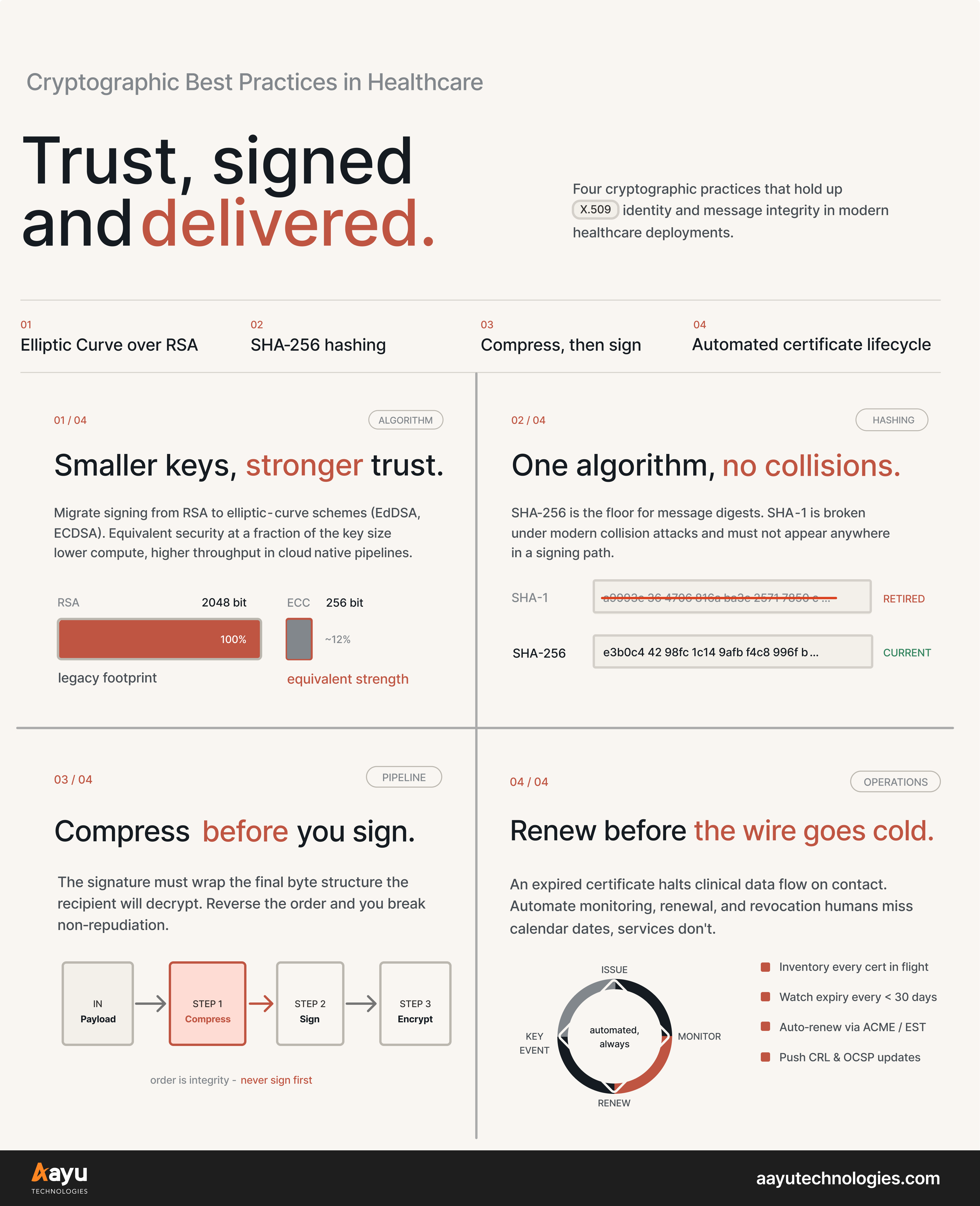
For healthcare deployments, the use of X.509 digital certificates is the primary method for establishing trust and verifying identity. These certificates are used to sign messages and receipts, providing verifiable proof of origin and ensuring that the content has not been tampered with during transit. Best practices for cryptographic implementation include:
Elliptic Curve Cryptography (ECC): Modern deployments should transition from older RSA algorithms to ECC (e.g., EdDSA or ECDSA). ECC provides stronger security with smaller key sizes, which reduces the computational overhead for high-volume message processing and improves performance in cloud-native architectures.
SHA-256 Hashing: The use of the SHA-256 algorithm is essential for protecting against collision attacks, replacing the now-obsolete SHA-1 standard.
Compression Order: For security integrity, payloads must be compressed before they are signed or encrypted. This ensures that the digital signature is applied to the final payload structure that will be decrypted by the recipient, maintaining the validity of the non-repudiation trail.
Automated Certificate Lifecycle Management: The expiration of a certificate can immediately halt the flow of clinical data, leading to operational delays or regulatory non-compliance. Organizations must implement automated tools to monitor certificate expiration, handle renewals, and manage revocation lists without human intervention.
The AS4 protocol’s ability to provide non-repudiation of receipt is a critical feature for healthcare providers and manufacturers. By using signed receipts, the sender receives cryptographic proof that the message was not only delivered but also acknowledged by the recipient’s system. This creates a robust audit trail that satisfies the accountability requirements of the General Data Protection Regulation (GDPR). In the event of a dispute or a compliance audit, these receipts provide legal evidence regarding who sent the message, who received it, and the precise timing of the exchange.
Ensuring the reliable delivery of data in a healthcare environment requires more than just a successful protocol handshake. Organizations must implement robust operational mechanisms to handle network failures, prevent data duplication, and manage sequence integrity.
One of the most critical requirements in healthcare messaging is ensuring that a message is processed exactly once. For instance, a pharmacy receiving an electronic prescription must ensure that a network retry does not result in the same prescription being filled twice, which could lead to significant patient safety risks. AS4 provides built-in duplicate detection by assigning a unique Message ID to every transmission. The MSH must maintain a state for these IDs and discard any duplicate messages it receives, even if the sender re-transmits the message due to a missing acknowledgment.
While “pushing” data is the standard method for B2B messaging, many healthcare entities operate within highly secure networks that block all incoming HTTP traffic. In these scenarios, the AS4 “Pull” interaction pattern is an essential best practice. It allows the internal system (the light client) to authenticate to a central server and pull pending messages. This pull mechanism typically utilizes the WS-Security UsernameToken Profile, where a digested username and password are included in the SOAP header to authorize the request.
Effective AS4 deployments require clear visibility into communication failures. The AS4 protocol defines standard, machine-readable error signals that unambiguously point out validation failures, security errors, or delivery issues. Best practices for error management include:
Standardized Error Receipts: The MSH should generate and visualize AS4 error codes (e.g., EBMS:0001 for security failures or EBMS:0004 for malformed XML) to help technical teams quickly diagnose problems.
Log Stream Analysis: Integrated logging should capture the entire message exchange, including the raw SOAP headers and cryptographic validation steps, to provide a complete context for troubleshooting.
Automated Alerting: High-priority errors such as a failure to deliver a vigilance report to EUDAMED should trigger automated alerts via email, Slack, or SMS to ensure immediate clinical awareness and remediation.
The European Database on Medical Devices (EUDAMED) serves as the regulatory cornerstone for the implementation of the EU Medical Device Regulation (MDR) and In Vitro Diagnostic Regulation (IVDR). To ensure the traceability of medical devices across the European market, EUDAMED mandates the use of the AS4 protocol for all machine-to-machine (M2M) communications.
While EUDAMED allows for manual data entry via its web portal, this approach is often unsustainable for manufacturers with extensive product portfolios. The volume of data required ranging from Clinical Investigation and Performance Study (CRF) data to Unique Device Identification (UDI) details makes automated submission a strategic necessity.
| Submission Method | Description | Efficiency and Scalability |
| Manual UI Entry | Data entered one field at a time via the EUDAMED website. | Low; high risk of human error and resource drain. |
| XML Bulk Upload | Users manually upload XML files via the EUDAMED portal. | Moderate; requires XML expertise; file size limits (max 300 UDIs per upload). |
| M2M Integration | Fully automated exchange using AS4 over the CEF e-Delivery network. | High; seamless data transfer; no technical file size limits; error-free. |
M2M communication using AS4 is particularly worthwhile for large data volumes because it removes the file size limitations inherent in the XML bulk upload method. For example, the XML bulk upload process often restricts submissions to 40-300 UDI-DIs per file, necessitating the fragmentation of large datasets into multiple manual uploads. In contrast, AS4 enables continuous, automated synchronization between the manufacturer’s internal system and EUDAMED, ensuring data integrity and reducing the risk of non-compliance penalties.
EUDAMED M2M communication operates through the Connecting Europe Facility (CEF) e-Delivery network. This network utilizes the e-SENS profile of AS4, which ensures that all messages are interoperable across different EU IT systems and organizations. The architecture relies on “Access Points” (APs); both the sender’s system and EUDAMED operate an AP that automatically exchanges and confirms messages. The use of this standardized network simplifies the integration process, as it provides a common cryptographic and messaging framework that is consistent across the EU.
Implementing a dedicated AS4 infrastructure can be technically daunting, requiring deep expertise in SOAP, WS-Security, and certificate management. Aayu Technologies addresses these challenges with its MFT Gateway, a cloud-native platform specifically engineered to handle the complexities of healthcare data exchange and EUDAMED integration.
The Aayu MFT Gateway is built on AWS serverless technologies, offering high availability and scalability without the need for traditional hardware or software maintenance. This architecture is particularly beneficial for healthcare organizations that require high-performance messaging during peak reporting periods but wish to avoid the high costs of maintaining dedicated server infrastructure. Organizations can also deploy the Aayu MFT Gateway into their own isolated AWS accounts as a custom deployment, ensuring complete data isolation and compliance with internal security policies.
The Aayu AS4 solution is pre-configured to handle EUDAMED’s specific profile rules and business logic. It simplifies the submission of regulatory information through:
PMode Agreement Management: The interface allows for the easy configuration of Processing Mode (PMode) attributes, which define the technical and legal rules for each message. This includes identifying the specific EUDAMED module (e.g., UDI, Actors, or Vigilance) and the action being performed (e.g., submitMessage).
Station and Partner Configuration: Users can configure a “Station” which represents their own organization, by adding the specific AS4 sender “Party ID Value” and “Party ID Type” assigned to you by EUDAMED. And, similarly set up the EUDAMED as a partner using their provided endpoint URL and party ID details.
Automated Retries and Reliability: The Aayu MFT Gateway strictly follows EUDAMED’s retry rules, automatically re-attempting delivery in the case of network transient failures.
Real-Time Status Visibility: A centralized dashboard provides full visibility into the status of every message, showing indicators for encryption, signature, and compression, along with the receipt status to confirm successful delivery to the regulatory database.
As we look toward the latter half of the decade, several trends are poised to shape the future of AS4 in healthcare. The transition to the AS4 2.0 specification will introduce even more advanced cryptographic suites, focusing on post-quantum security and further enhancements to the ebCore Agreement Update. This will allow organizations to update their messaging configurations and security certificates dynamically via AS4 messages themselves, further reducing manual maintenance.
Moreover, the mandatory use of EUDAMED is approaching a critical milestone. By May 2026, the registration of all new medical devices in the EU will move from national systems to the central EUDAMED database, making AS4 connectivity a “day zero” requirement for market access. Organizations that have already invested in robust AS4 solutions will be better positioned to navigate these deadlines without disruption to their commercial operations.
For organisations looking to connect to EUDAMED or evaluate AS4 support for other eDelivery-based platforms, we welcome the conversation. Contact the Aayu team to discuss your specific requirements.
Join hundreds of organizations already taking full control of their B2B AS2 communications with our trusted solutions. Contact us today to tailor a solution that fits your specific AS2 EDI needs.
Get full access to whichever product fits your needs. Configure real trading partner connections, run end-to-end transactions, and see the platform perform before making any commitment. All three products include a free 30-day trial with no restrictions.