









![Open-Source Transfer vs Managed File Transfer [Updated 2026]](/assets/images/blog/open-source-transfer-vs-managed-file-transfer.png)




Hosted SaaS solution for AS2 and SFTP file transfer. No infrastructure, instant setup.
Start Free Trial
Compare cloud, hybrid, and on-premise AS2 deployment in 2026. Which model fits your EDI volume, compliance needs, and trading partner onboarding speed?

Dithmeena Egodagamage
Published: 15 May 2026

Key takeaway
AS2 deployment in 2026 is no longer a single choice between on-premise and cloud. On-premise AS2 still fits regulated, stable, high-volume workloads. Cloud AS2 wins on scale, certificate management, and trading partner onboarding speed. Hybrid AS2 is where most mid-to-large enterprises actually land, and the right AS2 software vendor lets you run all three without re-platforming.
A decade ago, AS2 deployment meant one thing: a server rack in your own data centre. Today, the question is layered. Cloud or on-premise? Managed or self-hosted? Fully migrated, or hybrid? And underneath all of it, what does the future of AS2 deployment actually look like, and are you setting yourself up for it?
Many organisations still treat this as a purely technical infrastructure question, and they miss something important. The deployment model you choose for your AS2 software shapes how you compete, how fast you onboard trading partners, how confidently you meet compliance requirements, how well you absorb EDI volume growth, and how much of your IT team’s time gets consumed by maintenance instead of value work.
Here is an honest look at each model and what it means for AS2 EDI operations in 2026 and beyond.
The AS2 communication protocol is not going anywhere. It is built on open internet standards, mandated by major retailers and healthcare networks, and trusted across global supply chains because it delivers what other protocols do not: end-to-end encryption, digital signatures, and non-repudiation evidence through signed MDN(Message Disposition Notification) receipts. For a deeper primer on the protocol itself, see What is AS2 and how does it work?.
That is why organisations like Walmart, Target, and Amazon still require AS2-based EDI from their suppliers. The protocol has a clear future, governed by RFC 4130. What is changing is the infrastructure that runs it. And that decision, cloud, hybrid, or on-premise, is where the real future of AS2 deployment is being written right now.
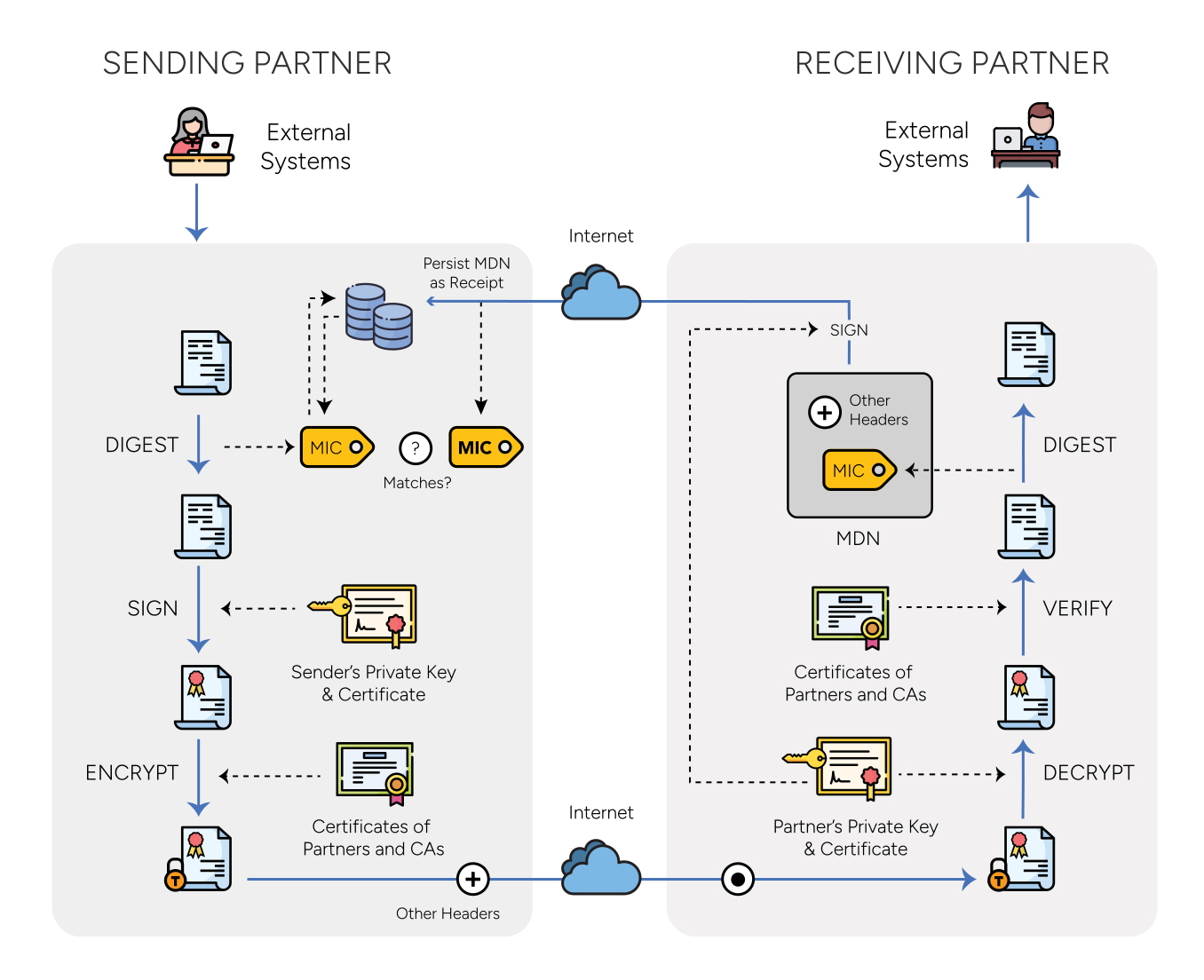
On-premise AS2 means your AS2 server software runs on hardware you own and manage, inside your own data centre. Your IT team controls everything: the certificates, the configuration, the network, the patching schedule, the disaster recovery plan. For specific organisations, on-premise is not a failure to modernise - it is the only viable model.
Banking institutions, government contractors, and certain healthcare organisations operate under frameworks - HIPAA, ITAR, local financial regulations, that mandate where sensitive data can physically reside. When your AS2 EDI transactions carry financial records or defence procurement data, no cloud vendor’s SOC 2 report substitutes for physical control. On-premise AS2 is often a compliance requirement, not a preference.
If your organisation runs stable, high-volume EDI workflows, thousands of AS2 transactions per day with well-understood trading partners, an on-premise AS2 server can be genuinely cost-efficient. The capital investment pays off when utilisation is high and predictable.
The server hardware is the visible cost. The invisible costs are: certificate lifecycle management across every trading partner, 24/7 availability expectations, disaster recovery infrastructure, and the specialist knowledge to keep everything running when something breaks at midnight.
When an AS2 trading partner rotates their certificate, your team owns that update. When EDI volume doubles unexpectedly, you are either over-provisioned or scrambling. AS2 server expertise is also a narrowing skill set, finding and retaining people who can manage AS2 server software reliably is harder and more expensive than it was five years ago. (For the operational reality, see our guide to troubleshooting AS2 EDI transfer issues.) On-premise AS2 belongs in your future if your regulatory environment demands it, your IT team has genuine AS2 operational depth, and your EDI workloads are large enough and stable enough to justify the ownership model.
Cloud-based AS2 file transfer software delivers the full AS2 protocol - encryption, MDN receipts, digital signatures, RFC 4130 compliance, as a managed service. Your organisation connects to the vendor’s infrastructure, and the operational weight shifts to them. This is where the AS2 market is growing fastest.
If you have run on-premise AS2, you know the certificate problem intimately. AS2 connections require public key certificate exchange with every trading partner, and when those expire unnoticed, your EDI channel goes dark. Modern cloud AS2 software vendors build certificate lifecycle management directly into the platform: automated expiration alerts, streamlined rotation, consistent policies across all partners. This alone has saved organisations from costly EDI outages.
On-premise AS2 server software is sized at a point in time. When a major retailer mandates AS2 and your transaction volume jumps, cloud AS2 scales automatically. Seasonal retail peaks, end-of-quarter financial surges, new large-partner onboarding, none of these require a hardware conversation first.
On-premise AS2 onboarding can take two to four weeks: server configuration, certificate exchange, endpoint setup, VPN coordination, and testing. Cloud AS2 communication software platforms have compressed this to hours, add partner identifiers and certificates through a UI, test, and go live the same day. For organisations responding to new retailer mandates or regulatory deadlines, that speed is commercially meaningful. Our complete guide to setting up B2B messaging on AS2 Gateway walks through what a cloud-native onboarding actually looks like.
Vendor dependency is real - your AS2 channel’s uptime depends on their infrastructure. Due diligence should go beyond the marketing page. Ask specifically: where does my AS2 data reside during transmission and at rest? What remedies exist if the SLA is missed? Which AS2 clients and servers does the platform interoperate with? How is MDN tracking handled across all trading partners?
Cloud AS2 belongs in your future if your AS2 EDI workloads are growing, your trading partner ecosystem is expanding, your IT team needs relief from operational overhead, or you are new to AS2 and want a faster path to compliance and production.
Want to see cloud AS2 in action? Start a free 30-day MFT Gateway trial - no credit card, full AS2 capability.
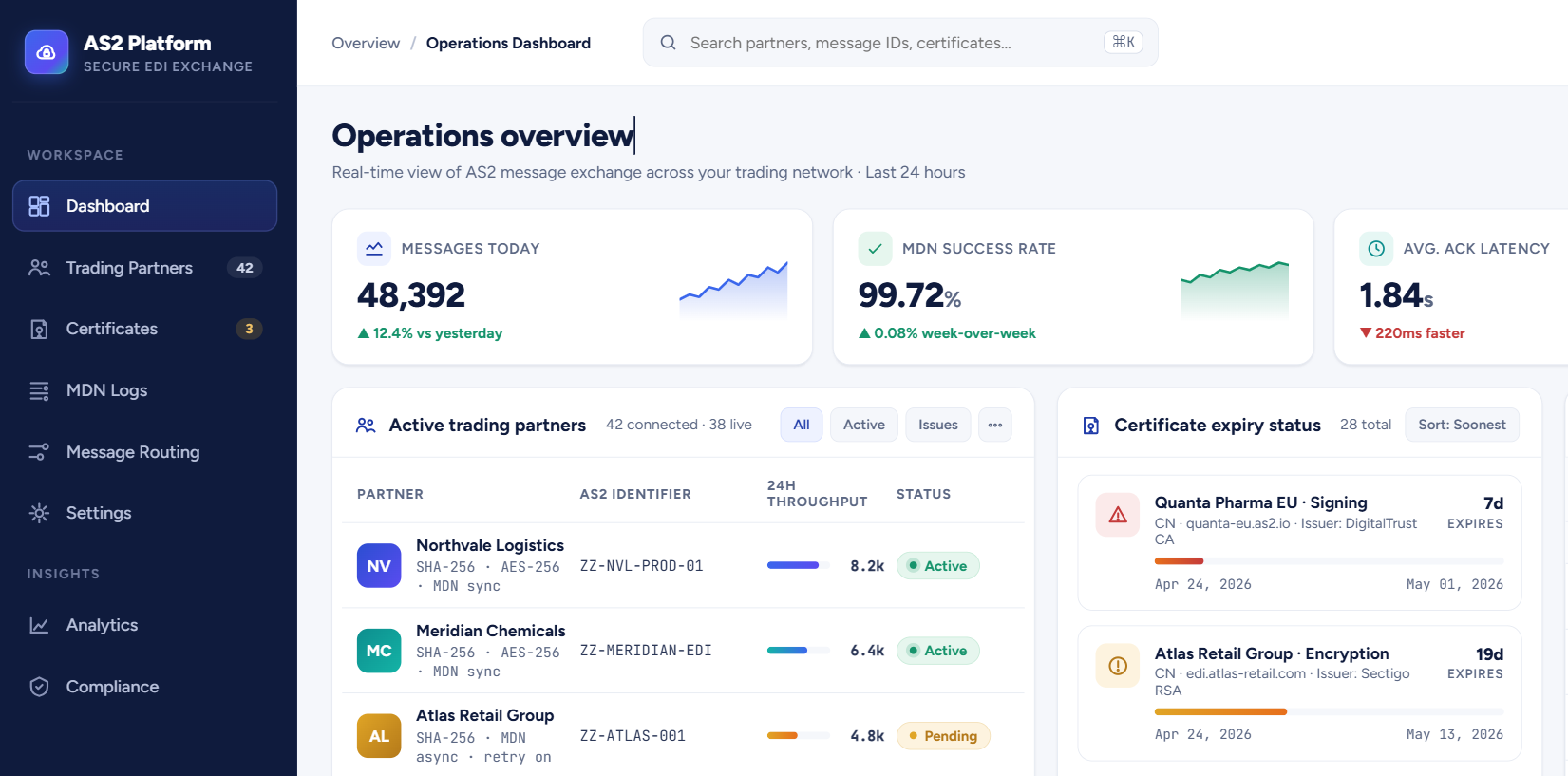
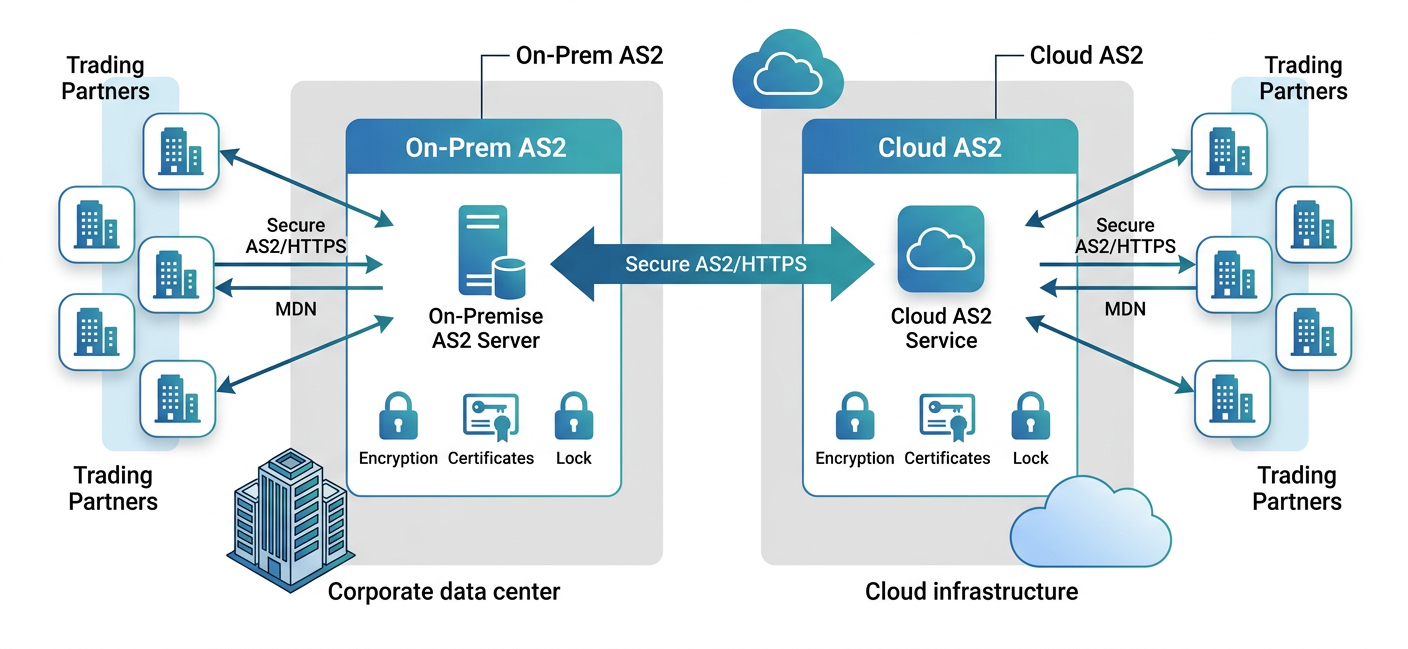
Most organisations are not in a position to be fully cloud or fully on-premise. They have legacy ERP integrations wired to on-premise AS2 servers that cannot re-route overnight, and new trading partner mandates, growing EDI volumes, and compliance requirements that aging infrastructure cannot absorb. Hybrid AS2 deployment is not a compromise. For most mid-to-large enterprises, it is the accurate description of where they will operate for the foreseeable future.
A healthcare organisation keeps HIPAA-regulated claims flowing through on-premise AS2 infrastructure, while routing commercial purchase orders through a cloud AS2 EDI platform that handles certificate management and scales elastically.
A manufacturer maintains on-premise AS2 connections for established trading partners embedded in legacy systems, while onboarding all new partners through a cloud AS2 service for faster setup and reduced overhead.
A logistics provider uses cloud AS2 server capacity to absorb peak-season volume spikes without permanently expanding their data centre footprint.
The risk in hybrid AS2 connectivity is fragmented visibility. If your on-premise AS2 server logs and cloud AS2 platform logs live in separate systems, your audit trail is incomplete - a real compliance risk in regulated industries. Organisations that make hybrid AS2 work well invest in unified logging, consistent MDN tracking, and governance policies that span both environments.
Hybrid AS2 belongs in your future if you have a mix of regulated and non-regulated AS2 workloads, legacy system integrations that cannot migrate immediately, or growing trading partner volumes that your on-premise AS2 server software cannot absorb without significant investment.
Cut through the framework noise. These four questions decide it.
If yes, those workloads need on-premise or private cloud. Everything else is open.
Stable, predictable traffic favours on-premise economics. Growing or seasonally spiking AS2 volumes favour cloud elasticity.
Certificate management, MDN tracking, AS2 server patching, trading partner troubleshooting - these require specific skills. If that expertise is thin or stretched, cloud or hybrid shifts the load to a specialist vendor.
Frequent onboarding - driven by new retail mandates or supply chain expansion - strongly favours cloud AS2 for speed and certificate management.
The future of AS2 server software deployment is not a single model winning. It is organisations matching each workload to the right infrastructure rather than defaulting to legacy patterns. Three forces are shaping this specifically for AS2.
Modern AS2 software vendors have invested heavily in regional data residency options, comprehensive MDN audit trails, and compliance certifications that address most enterprise requirements. The gap between cloud and on-premise AS2 compliance is narrowing - more workloads will migrate in the next few years.
The most forward-looking organisations use AS2 EDI for bulk structured data exchange - purchase orders, invoices, ASNs - while leveraging APIs for event-driven signals and real-time status updates. Hybrid deployment architectures support this blended approach naturally. We explored this in our piece on the future of AS2: trends and predictions.
When you fully account for hardware, specialist staffing, certificate management, and disaster recovery, cloud AS2 is often cheaper - even at meaningful transaction volumes. This is shifting more decisions toward the cloud every year. For teams already evaluating their next protocol layer, our AS2 to AS4 migration checklist is a useful companion read.
Whichever model fits your organisation today, your AS2 software vendor needs to give you room to evolve - not lock you into an architecture that served you three years ago.
A vendor positioned for the future of AS2 deployment should support all three models - on-premise AS2 server software, cloud-hosted AS2 file transfer software, and hybrid configurations that span both - with consistent protocol compliance, MDN tracking, certificate management, and audit logging across all of them.
Beyond deployment flexibility, look specifically for:
See how our AS2 Gateway supports both on-premise and cloud AS2 deployments, and how MFT Gateway delivers fully managed AS2 file transfer without the operational overhead of legacy infrastructure, both built around the same AS2 protocol standards your trading partners already expect.
AS2 is mandated by major retailers (Walmart, Target, Amazon), required by the FDA ESG, and trusted across global supply chains for its end-to-end encryption and MDN receipts. AS4 is gaining ground in healthcare and EU regulatory workloads (EUDAMED, PEPPOL), but AS2 remains the dominant protocol for retail and consumer-goods EDI. The two will coexist for years.
On-premise AS2 runs on hardware you own and manage - full control over certificates, configuration, and network, but your team owns every operational burden. Cloud AS2 is delivered as a managed service: the vendor handles infrastructure, certificate lifecycle, and scaling, while you connect via a UI or API. The protocol itself is identical; the operational model differs.
Hybrid AS2 fits when you have a mix of regulated workloads that must stay on-premise (HIPAA, ITAR, banking) and growing partner volumes that benefit from cloud elasticity. It’s also the right path when legacy ERP integrations can’t migrate quickly but new trading partners need fast onboarding.
Cloud AS2 platforms typically compress onboarding from 2–4 weeks (on-premise) to hours. You add partner identifiers and certificates through the UI, test the connection, and go live the same day. The reduction comes from removing server provisioning, VPN coordination, and manual certificate exchange from the critical path.
Look for RFC 4130 compliance, support for on-premise, cloud, and hybrid deployment from one platform, automated certificate lifecycle management, transparent data residency, MDN audit trails accessible to your compliance team, and onboarding workflows that match your trading partner velocity.
The future of AS2 deployment is not one model replacing the others. It is organisations making more deliberate choices, matching on-premise AS2 to workloads that genuinely require it, cloud AS2 to workflows that benefit from managed infrastructure and elastic scale, and hybrid AS2 connectivity to the mixed environments most enterprises actually operate in.
What separates organisations that get this right is not which model they choose. It is whether they choose it with clear eyes about their AS2 workloads, compliance requirements, IT capacity, and where their trading partner relationships are heading.
The AS2 communication protocol is built for the future. Your deployment model should be too.
Ready to evaluate AS2 deployment?
Start a free 30-day trial of AS2 Gateway for dedicated on-premise or cloud deployments, or MFT Gateway for fully managed cloud AS2 - no credit card, full AS2 capability from day one.
Join hundreds of organizations already taking full control of their B2B AS2 communications with our trusted solutions. Contact us today to tailor a solution that fits your specific AS2 EDI needs.
Get full access to whichever product fits your needs. Configure real trading partner connections, run end-to-end transactions, and see the platform perform before making any commitment. All three products include a free 30-day trial with no restrictions.