















































































































































































































MFT Gateway is a hosted Software as a Service (SaaS) solution that enables file exchange over the AS2 or SFTP protocol, without the need to install or maintain.
Start Free Trial
Learn where the AS4 protocol is mandatory across industries and regions. Discover global compliance requirements for AS4 EDI, e-invoicing, and secure B2B exchange.

Udith Gunaratna
Published: 17 Mar 2026

AS4 (Applicability Statement 4) is a secure communication standard designed to help businesses and government organizations exchange data reliably over the internet. The AS4 communication protocol is built on modern web services technologies such as SOAP and ebMS 3.0, delivering strong guarantees for security, reliability, and message integrity.
Thanks to these capabilities, AS4 has become a preferred choice for B2B integrations, AS4 EDI exchanges, e-invoicing systems, customs and trade platforms, e-government services, and supply chain messaging. Many organizations rely on AS4 software and an AS4 server to ensure compliant and secure data exchange across complex partner networks. While AS4 connectivity is currently most prevalent in Europe, global adoption of the AS4 protocol continues to grow rapidly.
This often leads to an important question: Is the AS4 protocol mandatory, strongly recommended, or simply a nice-to-have? The answer depends on several factors, including the industry you operate in, your trading partners, and the countries or regions where your business is active. In some cases, regulatory bodies explicitly mandate the use of the AS4 protocol, while in others, AS4 is recommended as a best practice for secure and standardized data exchange.
In this article, we’ll explore which business domains, countries, and regions currently mandate or recommend AS4 connectivity over other messaging protocols, and what that means for organizations evaluating or implementing AS4 software today.
Several industries and business domains have either mandated or strongly recommended the use of the AS4 protocol for secure and reliable business data exchange. The adoption of AS4 software continues to grow as organizations look for standardized and interoperable messaging solutions.
Many government bodies and public sector agencies have mandated the AS4 communication protocol for a wide range of data exchange scenarios, including:
The key strengths of AS4 protocol, including non-repudiation, auditability, and legally verifiable proof of delivery, have been major factors driving these mandates. As a result, AS4 EDI and secure AS4 server implementations are now common across government platforms.
The AS4 protocol is widely required by customs and trade facilitation systems around the world. Typical use cases include:
The growing adoption of AS4 in this domain is driven by its ability to provide reliable cross-border message delivery, strong identity and authentication mechanisms, and international interoperability. These features make AS4 protocol a trusted foundation for customs and trade-related data exchange.
In many countries, particularly across the European Union, the AS4 protocol has been mandated for Business-to-Business and Business-to-Government financial document exchanges. These requirements commonly apply to:
The need for secure, standardized, and interoperable messaging has made AS4 connectivity the preferred choice for e-invoicing platforms. Organizations typically rely on compliant AS4 software to support these regulated exchanges.
A key example is the PEPPOL network, a standardized framework for e-procurement and e-invoicing used across the EU. PEPPOL enables secure cross-border document exchange between public and private organizations and uses the AS4 communication protocol as its underlying transport layer for reliable and compliant data exchange.
The healthcare sector is another major adopter of the AS4 protocol, particularly in regulated environments where data security, traceability, and reliability are critical. In several countries, AS4 is mandated for healthcare-related data exchanges such as:
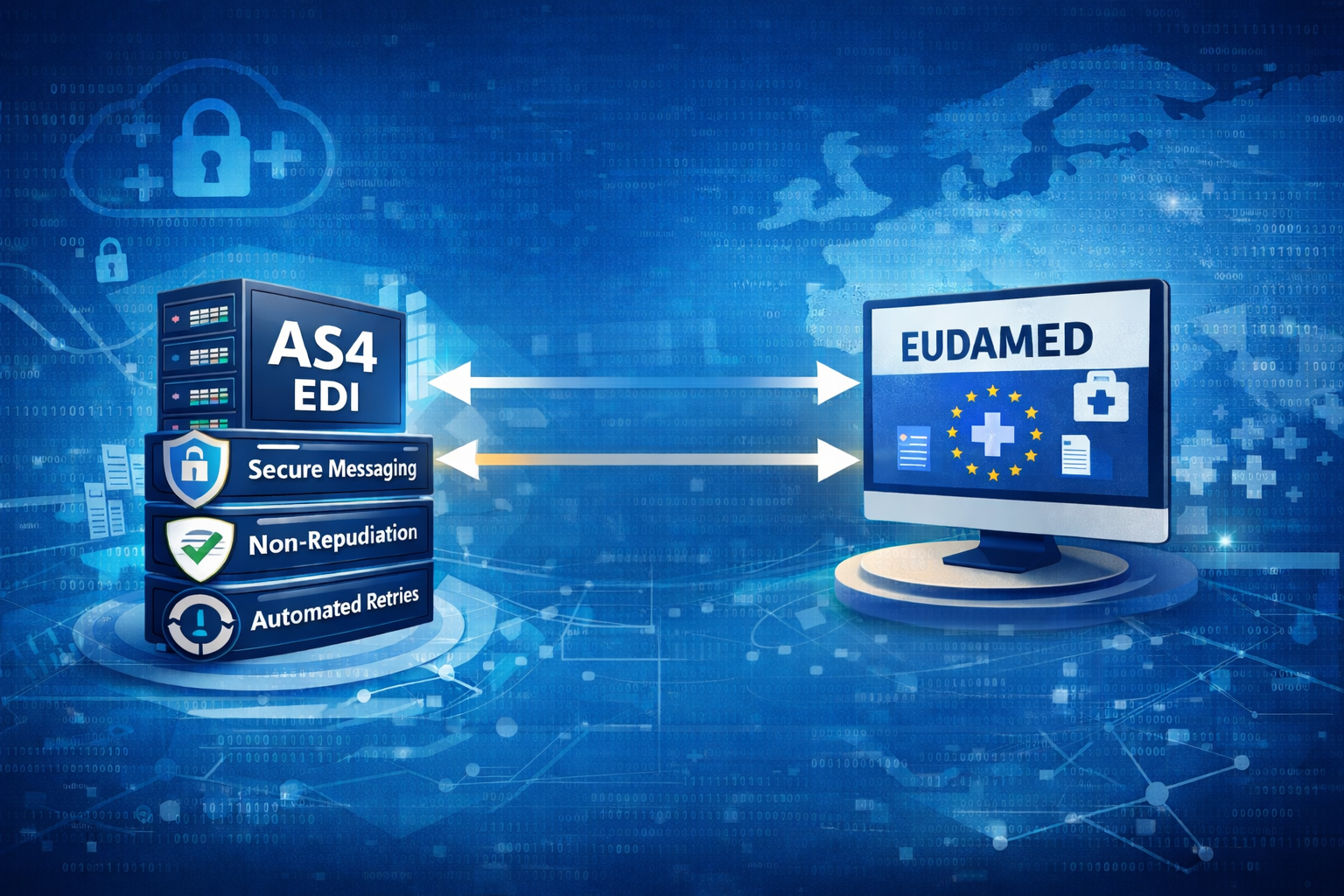
A notable example is EUDAMED, the European Database on Medical Devices. EUDAMED mandates that regulatory submissions be performed using the AS4 protocol, ensuring secure, auditable, and legally compliant communication between stakeholders.
The energy and utilities sector in regions such as the European Union is governed by strict regulatory frameworks. As part of these regulations, the AS4 protocol is widely used to support secure and reliable data exchange across energy markets, including:
The combination of strong security, guaranteed delivery, and cross-border interoperability makes AS4 protocol a trusted foundation for energy and utilities communication networks.
When looking at country and region specific adoption of the AS4 protocol, it becomes clear that regulatory maturity varies significantly across the globe. Some regions already rely heavily on AS4 connectivity for secure document exchange, while others are gradually incorporating AS4 communication protocol requirements into national regulations and standards.
The European Union is currently the largest adopter of the AS4 protocol, driven by regulatory initiatives and cross-border digitalization efforts. A key enabler of this adoption is the PEPPOL network, which uses the AS4 protocol to support secure and interoperable e-invoicing and e-procurement across member states.
Many European countries, including Austria, Croatia, France, Germany, and the United Kingdom, have mandated the use of PEPPOL for public sector and federal procurement e-invoicing. In addition, several countries are extending these requirements to B2B invoicing. Belgium, for example, has already announced the rollout of mandatory B2B e-invoicing starting in 2026. These initiatives have accelerated the deployment of AS4 servers and compliant AS4 software across Europe.
Several countries in the Asia Pacific region have also adopted the AS4 protocol as part of their national e-invoicing strategies. Singapore’s nationwide e-invoicing initiative, InvoiceNow, is based on the PEPPOL framework and relies on AS4 connectivity for secure document exchange.
Malaysia is similarly rolling out mandatory e-invoicing using PEPPOL-based infrastructure, while Japan has seen increasing adoption of PEPPOL and AS4 EDI among large enterprises seeking standardized and interoperable invoicing solutions.
Countries in the Middle East and Africa region are also beginning to adopt the AS4 protocol, particularly for regulated financial and invoicing exchanges. The United Arab Emirates has mandated e-invoicing for B2B and B2G transactions, with plans to integrate a PEPPOL-based ecosystem. These initiatives are driving demand for scalable AS4 software and robust AS4 server implementations to support national compliance requirements.
The adoption of the AS4 protocol continues to accelerate across industries, countries, and regions as regulatory bodies and enterprises prioritize secure, reliable, and interoperable data exchange. From government and customs systems to e-invoicing networks, healthcare platforms, and energy markets, AS4 connectivity has become a trusted foundation for compliant digital communication.
While AS4 is already mandatory in several domains and regions, particularly in Europe, many other countries are actively integrating AS4 communication protocol requirements into their regulatory frameworks. This trend indicates that AS4 EDI, supported by robust AS4 servers and compliant AS4 software, is moving from a regional standard to a global best practice.
For organizations operating across borders or in regulated environments, understanding industry and region specific AS4 protocol requirements is critical. Proactively adopting AS4 software not only ensures regulatory compliance but also improves long-term scalability, interoperability, and security in B2B and B2G integrations.
As global digital transformation initiatives continue to evolve, AS4 is well positioned to remain a core messaging standard for secure and compliant business communication in the years ahead.
Contact us today for more details on our upcoming release and how we can support your migration strategy.
Join hundreds of organizations already taking full control of their B2B AS2 communications with our trusted solutions. Contact us today to tailor a solution that fits your specific AS2 EDI needs.
No commitment, all value. Try the AS2 Solution Risk-Free and discover how our solutions can transform your business workflows. No credit card required.