






































































































































































































MFT Gateway is a hosted Software as a Service (SaaS) solution that enables file exchange over the AS2 or SFTP protocol, without the need to install or maintain.
Start Free Trial
Compare AS4 vs AS2 and discover why enterprises are upgrading to AS4 for scalable, reliable, cloud-ready B2B messaging and EDI integration.

Lahiru Ananda
Published: 13 Jan 2026

If you have worked with B2B integration for a while you are probably very familiar with AS2 communication protocol. AS2 has been a presence in the B2B integration world for a while and it is like a good old friend that you can rely on. Sometimes AS2 can be a little tricky to work with but it always gets the job done. For years AS2 has been quietly moving EDI files and managing B2B communication without any issues.
Nowadays people are talking about AS4 all the time. You hear about AS4 at every meeting. What is the reason for this change from AS2, to AS4? It’s simple: The digital landscape AS2 was originally built for simply doesn’t exist anymore.
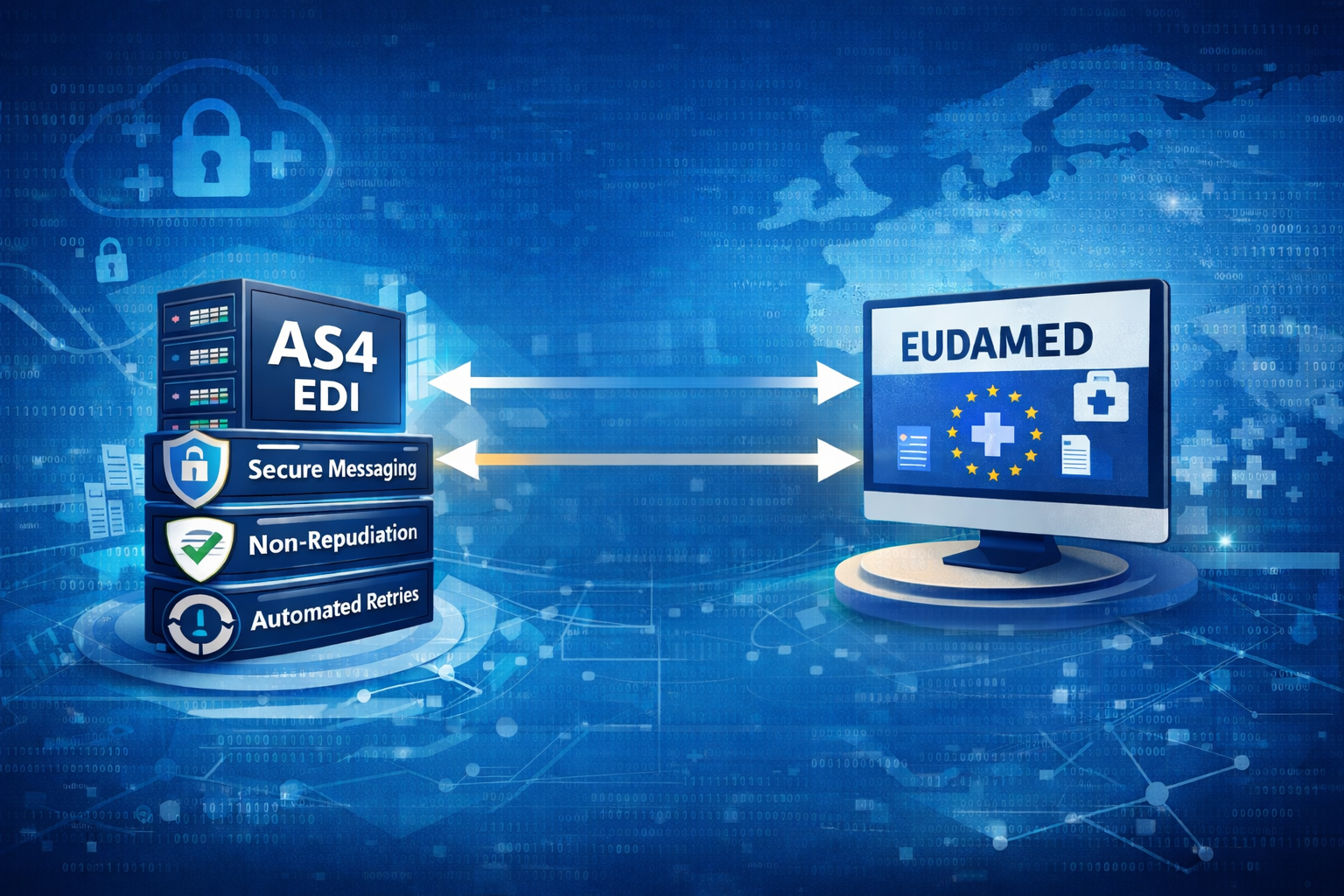
Read more: Introducing Aayu AS4 Server for Seamless EUDAMED Integration
Let us give credit where it’s due: AS2 was built for a different era of business. AS2 really did well back then when your partner list was small and manageable. All of your information was on-prem, stored on a server in your building and point-to-point connections were the best way to do things.
AS2 still works, but if you’re managing it at scale, you’ve felt the cracks. You know the drill: the sender and receiver are basically joined at the hip. If one side hiccups, the whole synchronous flow collapses. As your partner list grows, the configuration starts to feel like a house of cards, and there’s nothing worse than flying blind when a critical transfer fails at 2:00 a.m.
AS2 isn’t broken. It’s just stretched beyond what it was designed for.
Read more:Comprehensive Guide to AS2 Protocol
The AS4 system was not introduced to take the place of the AS2. The AS4 system came into existence because the world of enterprise integration became a lot more complex. Nowadays, we have to deal with more partners, heavier traffic, stricter compliance. With a massive shift to the cloud, AS2 started to feel like it was holding us back.
On paper, AS4’s foundation, things like SOAP, ebMS 3.0, and WS-Security, can look a bit intimidating. But there’s a reason for that “heavy” architecture: it’s what allows for truly decoupled, reliable messaging. It’s the difference between a direct wire that breaks when moved and a flexible, enterprise-grade mesh that stays standing no matter what.

In the AS2 world, a file transfer is like making a phone call: both parties have to be on the line at the exact same time or connectivity does not work. Whenever that receiving server drags or goes offline, the call drops. And you can guess what takes place in production due to that: the queues build up, the systems stall, and someone eventually gets a notification they didn’t want.
AS4 changes that dynamic by making messages much more like modern email or Slack: it’s natively asynchronous. Messages queue up, retries happen automatically, and the file lands when the recipient side is ready to listen.
What this may look like on your team:
Zero “Blink” Failures: You stop worrying about minor network hiccups.
Automatic Resilience: The system will handle the logic of “try again in 5 minutes” for you.
A Better Night’s Sleep: Far fewer midnight alerts triggered by temporary downtown on a partner’s end.
AS2 uses MDN (Message Disposition Notifications) to confirm delivery. While effective, they can sometimes feel like a “best-effort” confirmation; if you do not receive an MDN, you will wonder if your network dropped the message, if your partner’s server hung or shut down, or if your partner received the message and just did not acknowledge receipt.
AS4 provides reliable messaging as an inherent feature. It’s not something you add to the protocol. You can think of reliable messaging in AS4 as an insurance policy for your information. Think of it as an insurance policy for your data:
Auto Retry: The application can automatically attempt to redeliver messages that failed delivery to your partner based on the configured retrying policies, without requiring you to write any custom code or manually connect.
Duplicate Detection: With AS4, a message is guaranteed to be processed only once by identifying the unique message ID and conversation ID.
Message Ordering: AS4 provides a mechanism to group and order messages conversationally so that the MSH (Message Service Handler) knows how to identify and safely process out-of-order messages.
Full Transparency: With AS4, all messages have centralized state and receipts so every message can be verified, creating an auditable record that clears up doubts as to whether or not your partner received your shipping notice.
The AS2 protocol provides asynchronous messaging support; however, AS2 often suffers from scalability limitations due to its tightly coupled nature of its message state and the receipt reconciliation process. Most AS2 deployments manage all of the transmission, receipt tracking, and persistence process through a single instance. This nature often impedes the ability for horizontal scaling and forces teams to rely on vertical scaling options. This means you just have to buy more powerful and more expensive resources. Trying to scale a production AS2 server often feels like upgrading a car’s engine while driving it down the highway, it’s complicated, messy, and risky.
The AS4 protocol provides more modularity for decoupling such concerns. Message context is defined using standardized SOAP headers and ebMS 3.0 headers, and the processing state can be persisted centrally. This creates the ability to deploy AS4 Message Service Handlers as Stateless Workers, allowing true horizontal scaling in Cloud and container-based architectures. Therefore, any worker instance can handle inbound messages or acknowledgements without needing to attach itself to any particular server instance.
AS4’s pull model gives recipients more control over the message receiving process compared to AS2. Instead of inundating the recipient with overwhelming inbound messages during peak hours, now they have the option of requesting their messages as-needed basis. Therefore, AS4 is ideal for bulk loading of high-volume integration scenarios, where throughput and elasticity are paramount to the success of these implementations.
AS2 gateway and AS4 gateway both use standards compliant security mechanisms that provide considerable security; however, how they achieve this differs. For example, AS2 employs S/MIME to secure a message, encrypting the entire payload as one unit. This model is secure; however, it makes the content of the message opaque to intermediate users, thus limiting their ability to route, inspect, and enforce policy on the messages unless the complete message is decrypted.
On the other hand, AS4 uses WS-Security, which aligns the mechanism used to secure messages with current web service standards. This enables a much more granular approach to determining what content within a message is signed and/or encrypted, thus allowing sensitive business information to remain protected, while some header information remains visible/integrity-protected and therefore able to be routed through B2B hubs, firewalls, and load balancers.
From the perspective of compliance, AS4 using web-based security mechanisms allows for an easier integration with both cloud security technologies, as well as centralised audit frameworks, compared to AS2. AS4 does not eliminate the non-repudiation support provided by AS2, however, it does provide a more flexible and interoperable security solution for multi-party, cloud native integration environments.
AS4 simplifies the configuration, security, and routing of messages by providing a single, standards-compliant way to manage a large number of trading partners in one location. AS4 offers the ability to have multiple trading partners utilize the same Message Service Handler (MSH) infrastructure and uses Conversation IDs, and unique credentials, to maintain separation. Security policies such as WS-Security signatures, encryption, and certificate management can be applied uniformly across all trading partners, thereby simplifying administration and minimizing the likelihood of error. AS4 is also fully compatible with current B2B networks such as PEPPOL, “national” e-invoicing platforms, and EDI hubs, allowing organizations to rapidly and effectively onboard new trading partners into their business processes.
Read more: AS2 vs. AS4: Choosing the Right Protocol for Your Business Needs
Companies use AS4 for legitimate reasons. AS4 resolves the daily difficulties they encounter when they attempt to integrate their companies on a B2B platform, especially as a result of the overall increase in volume of transactions and the number of partners with whom they connect. In addition to providing the architecture (the “building blocks”) that achieve this, AS4 will enable you to be able to provide and manage your eCommerce systems more efficiently.
AS2 won’t vanish soon; lots of businesses still use it for old-fashioned integrated networks and can meet their compliance and security requirements using it. For now, AS2 offers a reliable and known solution for organisations who already have many existing B2B networks and not too many needs to modernise.
However, as organisations are moving toward cloud, multi-partner ecosystems, and bulk, asynchronous integration, they are speeding up adoption of AS4. AS4 has inherent reliability and scalability, along with ability to support current generation networks such as PEPPOL, so it has become the best choice for organisations developing new integrations. More businesses are beginning to operate both AS2 and AS4 concurrently while they continue to migrate towards AS4 to build on messaging solutions ready for the future of the enterprise.
Discover how a production-ready AS4 Gateway enables high-volume, asynchronous B2B messaging across hundreds of trading partners, without the operational complexity of legacy AS2.
Contact us to be notified as soon as our AS4 solution goes live.
Join hundreds of organizations already taking full control of their B2B AS2 communications with our trusted solutions. Contact us today to tailor a solution that fits your specific AS2 EDI needs.
No commitment, all value. Try the AS2 Solution Risk-Free and discover how our solutions can transform your business workflows. No credit card required.