











Hosted SaaS solution for AS2 and SFTP file transfer. No infrastructure, instant setup.
Start Free Trial
EUDAMED legacy device registration explained: the 27 November 2026 deadline, actor registration, upload options (GUI, XML, M2M) and AS4 access points.

Adeesha Jayasinghe
Published: 25 Nov 2026

TL;DR: EUDAMED’s Actor, UDI/Device, Notified Bodies and Certificates, and Market Surveillance modules became mandatory on May 28, 2026. Legacy devices placed on the EU market before that date and still being placed on the market afterward must be registered in the UDI/DEV module by November 27, 2026. Manufacturers can register through the web interface, XML bulk upload, or machine-to-machine (M2M) integration, which requires an AS4 Access Point on the CEF eDelivery network.
The European database on medical devices (EUDAMED) is no longer a theoretical compliance requirement. On November 27, 2025, the European Commission published Decision 2025/2371 in the Official Journal of the European Union, confirming that four core EUDAMED modules are fully functional. This official publication started a six-month transition period under Regulation 2024/1860. On May 28, 2026, using these functional modules became mandatory across the European Economic Area.
While new medical devices certified under the Medical Device Regulation (MDR) and In Vitro Diagnostic Regulation (IVDR) must be registered before market entry, manufacturers of legacy devices face a separate crucial deadline. Devices already on the market that benefit from extended transitional periods must complete registration in EUDAMED by November 27, 2026. Meeting these compliance deadlines requires a clear understanding of regulatory schedules, data governance standards, and technical connectivity options such as the AS4 communication protocol.
Under the original framework of regulation (EU) 2017/745 (MDR) and regulation (EU) 2017/746 (IVDR), EUDAMED was intended to launch as a single platform containing six fully integrated modules. However, development complexities made it difficult to release all six modules at the same time. To prevent compliance bottlenecks and improve market transparency sooner, the European Parliament and Council enacted Regulation 2024/1860, which authorized a gradual, module-by-module deployment. Under this modified approach, individual modules undergo independent audits by the European Commission. Once an audit confirms full technical functionality, the Commission publishes an official notice in the Official Journal of the European Union.
The publication of Commission Decision 2025/2371 on November 27, 2025, formally confirmed that the first four modules met all design specifications. These operational modules include Actor Registration, Unique Device Identification and Device Registration (UDI/DEV), Notified Bodies and Certificates, and Market Surveillance. The remaining two modules, covering Vigilance/Post-Market Surveillance and Clinical Investigations/Performance Studies remain under development and are scheduled for mandatory release in 2027. This phased rollout allows economic operators to adapt their data systems step by step rather than managing a simultaneous transition across all regulatory functions.
The official notice published on November 27, 2025, activated specific countdown periods for different user groups and product categories. Understanding how these dates apply to specific portfolios is essential for maintaining legal market access.
| EUDAMED Module | Target Stakeholder | Mandatory Enforcement Date | Core Compliance Requirement |
|---|---|---|---|
| Actor Registration (ACT) | All Economic Operators | May 28, 2026 | Register organizational details and obtain a validated Single Registration Number (SRN). |
| New MDR/IVDR Devices | Manufacturers & Authorized Reps | May 28, 2026 | Register Basic UDI-DI and device attributes before placing the first unit on the market. |
| Market Surveillance (MSU) | Competent Authorities | May 28, 2026 | Use the module for cross-border surveillance coordination and official communication. |
| Ongoing Legacy Devices | Manufacturers & Authorized Reps | November 27, 2026 | Complete full UDI registration for legacy devices placed on the market before May 28, 2026, that continue to be distributed. |
| Notified Body Certificates | Notified Bodies | May 27, 2027 | Upload active historical MDR and IVDR certificates issued prior to mandatory system use. |
The May 28, 2026, deadline establishes an immediate market entry requirement for new medical technology. Any new device certified under MDR or IVDR must be registered in EUDAMED before the first unit can be lawfully placed on the European market.
Legacy devices follow a separate timeline. These are products approved under former directives that remain legally on the market during transitional extensions. If a legacy device entered the EU market before May 28, 2026, and will continue to be placed on the market afterward, manufacturers have until November 27, 2026, to complete its device registration. Some sources cite November 28, 2026, because the 12-month period runs from the November 27, 2025 notice, so treat November 27 as the safe cut-off. Devices with no units placed on the market from May 28, 2026, generally do not require registration unless a post-market surveillance or vigilance action, such as a serious incident report or field safety corrective action, applies.
Establishing actor credentials is the prerequisite for all interactions within EUDAMED. Economic operators including EU manufacturers, non-EU manufacturers, Authorized Representatives, importers, and System/Procedure Pack Producers must complete registration in the Actor module to receive a Single Registration Number (SRN).
The actor registration workflow begins when an organization creates an EU Login account through the Commission’s web portal. The first person to submit an actor registration on behalf of an organization automatically becomes the initial Local Actor Administrator. The submission must include corporate details, trade names, physical addresses, organizational roles, and details regarding the Person Responsible for Regulatory Compliance (PRRC).
The validation pathway depends on where the economic operator is established:
Once actor registration completes, companies must select a technical method to upload device data into the UDI/DEV module. Registering a device family requires linking four related objects: the Basic UDI-DI (the regulatory anchor for devices sharing the same purpose and risk class), individual UDI-DIs (commercial package codes), attribute datasets, and notified body certificates. EUDAMED provides three upload methods to accommodate different portfolio sizes. As a rule of thumb, the table below shows which method suits each portfolio size.
| Technical Metric | Manual Web Interface (GUI) | XML Bulk Upload (BLK) | Machine-to-Machine (M2M) |
|---|---|---|---|
| Portfolio Size Suitability | Small portfolios under 100 devices | Mid-sized portfolios between 100 and 1,000 devices | Enterprise portfolios exceeding 1,000 devices |
| Operational Mechanism | Direct manual data entry into web forms | Browser-based upload of pre-formed XML files | Direct server-to-server automated streaming via AS4 |
| Technical Requirements | Standard internet browser and EU Login account | Offline XML generator and schema validation tools | CEF eDelivery Access Point and compliant AS4 software |
| Validation Mechanism | Immediate browser form checks | Pre-upload XML schema verification | Automated two-tier validation engine |
| Operational Error Risk | High risk of typing errors and long processing times | Moderate risk during manual file handling | Minimal risk due to automated system-to-system validation |
Manual entry through the web interface works well for small product catalogs, but manual typing becomes slow and error-prone as product volumes increase. The XML Bulk Upload pathway allows mid-sized companies to prepare product data offline and upload files through the portal. However, Bulk Upload limits files to 300 device entities per transmission. Large catalogs must be split into multiple files, which increases manual file handling.
For companies managing large product lines or multiple international brand portfolios, Machine-to-Machine (M2M) integration offers the most reliable long-term solution. M2M connects corporate Enterprise Resource Planning (ERP) or Product Lifecycle Management (PLM) databases directly to EUDAMED, eliminating manual file uploads.
Regardless of the submission method, all incoming product data must pass two strict validation checks:
Because missing fields or incorrect attributes cause full submission rejections, organizations must validate their documents thoroughly before uploading.
To enable automated M2M communication, the European Commission mandates the use of the Applicability Statement 4 (AS4) protocol. This communication standard operates across the Connecting Europe Facility (CEF) eDelivery network, using the e-SENS profile to guarantee secure, encrypted, and reliable data delivery.
The M2M exchange topology relies on three main technical components:
Comparing protocols for healthcare data? Read AS2 vs AS4 in healthcare →
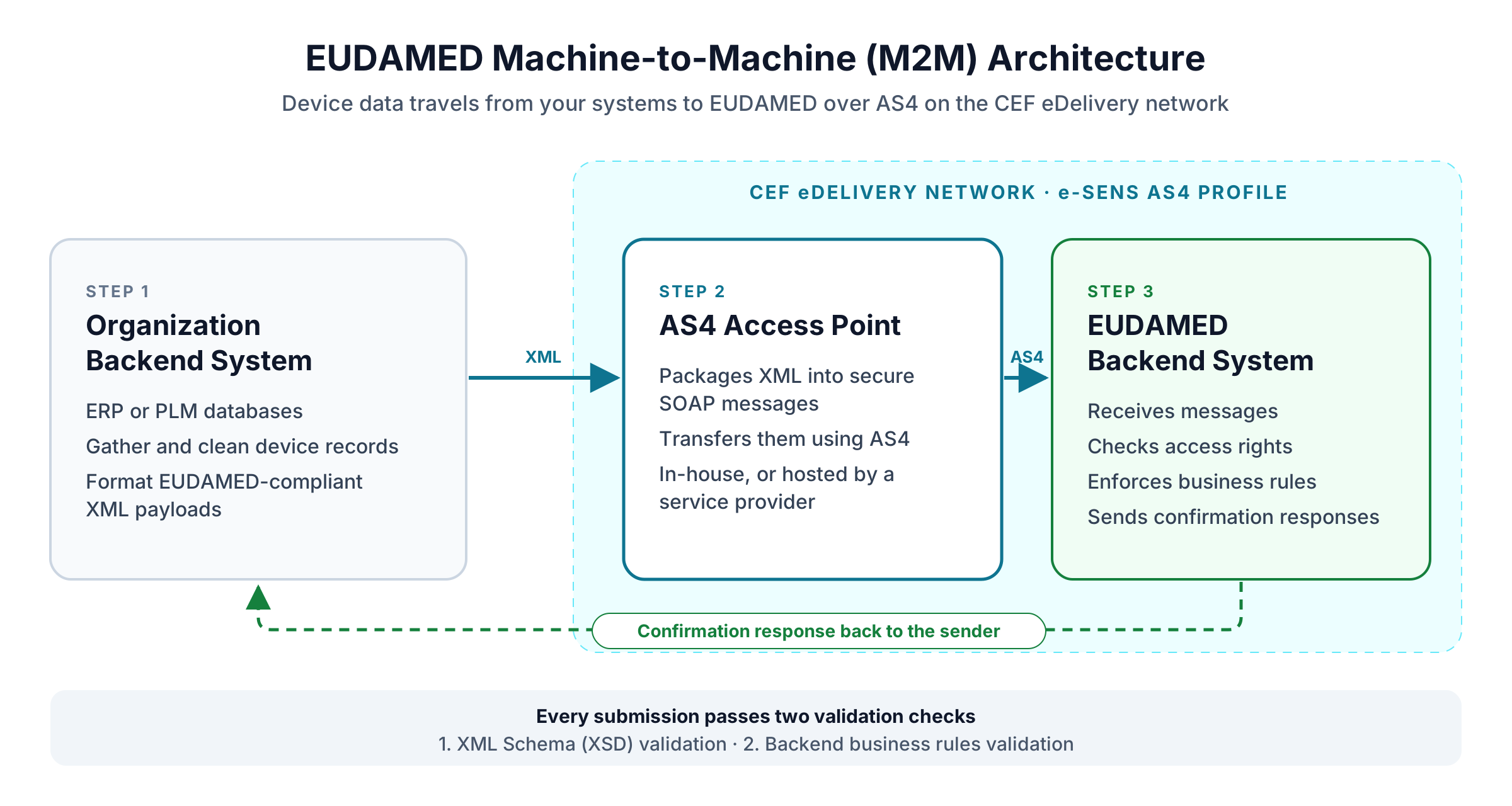
Setting up an active M2M connection requires completing several implementation steps:
Building an in-house AS4 Access Point requires significant IT resources and ongoing software maintenance. Because of this technical complexity, many manufacturers choose to connect through specialized third-party software providers. These providers maintain pre-configured Access Points that handle schema updates and cryptographic protocols, allowing regulatory teams to focus on master data accuracy. See how Aayu AS4 Server connects manufacturers to EUDAMED →
To prepare for upcoming enforcement dates, medical technology companies should implement a clear five-step action plan.
Registering a large portfolio through M2M? Aayu AS4 Server provides an AS4 Access Point for EUDAMED, so your regulatory team can focus on device data instead of protocol maintenance. Talk to our team.
November 27, 2026, closes the EUDAMED registration window for existing devices, not your ongoing regulatory obligations. Any legacy device still placed on the EU market requires UDI/DEV registration, with no grace period, unless the same device is already registered under the MDR or IVDR. Teams finishing late submissions should immediately prioritize devices actively being placed on the EU market.
Registration is also not a one-time task. Device modifications, certificate updates, and changes to product attributes must be reflected in EUDAMED over time. This is where internal change-control procedures, and automated M2M submissions for larger portfolios, keep records accurate without repeated manual work.
Legacy devices placed on the EU market before May 28, 2026, that continue to be placed on the market afterward must be registered in the EUDAMED UDI/DEV module by November 27, 2026. Some sources cite November 28, so treat November 27 as the safe cut-off.
Generally no. Devices with no units placed on the market from May 28, 2026, do not need registration, unless a post-market surveillance or vigilance action, such as a serious incident report or field safety corrective action, arises.
Four modules have been mandatory since May 28, 2026: Actor Registration, UDI/Device Registration, Notified Bodies and Certificates, and Market Surveillance. The Vigilance and Clinical Investigation modules are still under development.
XML bulk upload lets you prepare device data offline and upload files through the EUDAMED portal. Machine-to-machine (M2M) integration connects your ERP or PLM system directly to EUDAMED over AS4, removing manual file handling, which suits large portfolios.
Only for M2M integration. The web interface and XML bulk upload work through a browser with an EU Login account. M2M requires an AS4 Access Point on the CEF eDelivery network, which you can build in-house or use through a provider.
Join hundreds of organizations already taking full control of their B2B AS2 communications with our trusted solutions. Contact us today to tailor a solution that fits your specific AS2 EDI needs.
Get full access to whichever product fits your needs. Configure real trading partner connections, run end-to-end transactions, and see the platform perform before making any commitment. All three products include a free 30-day trial with no restrictions.