







![Open-Source Transfer vs Managed File Transfer [Updated 2026]](/assets/images/blog/open-source-transfer-vs-managed-file-transfer.png)





Hosted SaaS solution for AS2 and SFTP file transfer. No infrastructure, instant setup.
Start Free Trial
Compare AS4 vs AS2 in 2026. Learn differences in security, efficiency, AS2 server setup, AS4 EDI, and modern B2B connectivity.

Sandeepani Rathnayaka
Published: 30 Jul 2026
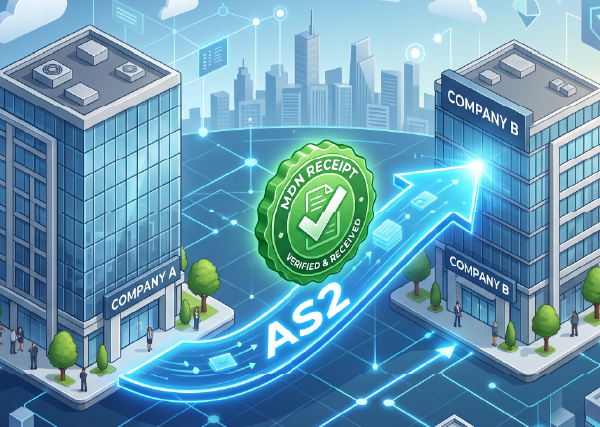
AS4 vs AS2 is a critical comparison for organizations handling secure B2B data exchange in 2026.
While AS2 has been the industry standard for EDI communication for many years, modern requirements around security, scalability, and cloud-based integration are pushing enterprises to evaluate AS4 as a future-ready alternative.
Both the AS2 communication protocol and AS4 EDI are designed to securely exchange business documents over the internet. However, they differ significantly in how they handle message reliability, encryption, scalability, and long-term efficiency.
In this guide, we compare AS4 vs AS2 in terms of security and efficiency, helping you decide which protocol best fits your organization’s B2B integration strategy in 2026.
Before diving deeper into technical details, here is a quick summary of the main differences between AS4 and AS2.
| Category | Best Choice |
|---|---|
| Best for small and medium businesses | AS2 |
| Best for large regulated enterprises | AS4 |
| Cloud-native architecture | AS4 |
| Legacy partner compatibility | AS2 |
| Multi-partner networks | AS4 |
| Simple point-to-point EDI | AS2 |
In simple terms, AS2 is still widely used for direct partner communication, while AS4 is designed for modern, scalable, and cloud-ready B2B integration environments.
Many organizations continue using AS2 for existing integrations while gradually exploring AS4 for future-ready messaging networks.
AS2 (Applicability Statement 2) is a widely used EDI communication protocol that enables secure data exchange over HTTP or HTTPS.
It is commonly implemented using an AS2 server, which manages:
Organizations that rely on stable, point-to-point EDI connections often use dedicated AS2 connectivity platforms, such as secure AS2 Gateway solutions, to simplify partner onboarding and communication.
AS2 EDI remains popular due to its simplicity and reliability, especially for direct partner integrations with predictable message volumes.
AS4 is a next-generation B2B messaging standard based on ebMS3 and web services.
Unlike AS2, AS4 communication is designed for modern integration environments that require scalability, reliability, and compliance.
AS4 is particularly well-suited for the following:
An AS4 server enables advanced message handling such as the following:
AS4 is widely adopted in regulated environments where auditability and reliability are mandatory, as seen in AS4 server implementations for regulated integrations.
While AS2 and AS4 both support secure data exchange, they differ significantly in their underlying architecture.
AS2 is based on HTTP transport combined with MIME and S/MIME standards. Messages are transmitted directly between two partners over HTTP or HTTPS.
The typical AS2 architecture includes:
AS2 follows a simple point-to-point communication model, where each partner connects directly to the other partner’s AS2 server.
This simplicity is one of the reasons why AS2 has been widely adopted for many years.
AS4 uses a more advanced architecture built on SOAP web services and the ebMS3 messaging standard.
Key components of AS4 architecture include the following:
Like AS2, AS4 supports message-level security. Its key advantage is that it uses modern web service standards, making it better suited for multi-hop routing, distributed networks, and complex B2B integrations.
Both AS2 and AS4 provide strong security mechanisms for protecting business data during transmission. However, they implement security using different technologies.
AS2 uses HTTPS to secure the communication channel and S/MIME to digitally sign and encrypt messages. This provides both transport-level and message-level security for secure B2B data exchange.
AS4 uses WS-Security standards to apply digital signatures and encryption directly to SOAP messages. It also supports advanced messaging capabilities, making it well suited for multi-hop routing, distributed networks, and complex B2B integrations.
Because of this architecture, AS4 can provide stronger protection in complex multi-party environments.
Winner for security in 2026: AS4, especially for regulated industries and large partner networks.

Performance, scalability, and reliability are key factors when comparing the efficiency of AS2 and AS4.
Winner for efficiency: AS4, particularly for cloud-based architectures.
When choosing between AS2 and AS4, organizations must also consider implementation complexity and operational costs.
AS2 implementations are generally easier to set up because the protocol is simpler.
Typical AS2 deployment tasks include:
However, as the number of partners increases, managing certificates and partner configurations can become more complex.
AS4 deployments usually require more advanced infrastructure because the protocol is based on web services and enterprise messaging standards.
Organizations often need:
However, AS4 offers long-term advantages for organizations operating large integration networks.
| Factor | AS2 | AS4 |
|---|---|---|
| Initial setup complexity | Low | Medium |
| Infrastructure requirements | Basic | Advanced |
| Partner onboarding effort | Manual | More automated |
| Scalability cost | Higher with growth | More efficient at scale |
| Cloud deployment | Limited | Designed for cloud |
For smaller partner networks, AS2 may remain more cost-effective, while AS4 becomes more efficient for large enterprise integrations.
| Feature | AS2 | AS4 |
|---|---|---|
| Protocol Type | HTTP-based | Web services (ebMS3) |
| Security | Strong | Advanced |
| Scalability | Limited | High |
| Cloud Readiness | Medium | Excellent |
| Message Reliability | MDN-based | Built-in |
Different industries adopt AS2 and AS4 based on their operational requirements and regulatory environments.
Retail and supply chain industries still rely heavily on AS2 EDI communication. Many large retailers already require suppliers to connect using AS2, making it a stable and trusted standard.
Government systems and international digital trade frameworks increasingly rely on AS4 messaging.
For example, European digital communication frameworks use AS4 because of its strong reliability and security capabilities.
Healthcare organizations are gradually exploring AS4-based EDI messaging due to its improved security, audit capabilities, and support for high-volume messaging.
However, many healthcare networks still operate hybrid environments where AS2 remains part of existing integrations.
Large manufacturing ecosystems often operate complex multi-partner networks. These environments benefit from AS4’s reliable messaging and advanced routing capabilities.
As a result, some organizations are adopting hybrid models where both AS2 and AS4 are supported simultaneously.
Many organizations are not replacing AS2 immediately but instead adopting gradual migration strategies.
A common approach is to run AS2 and AS4 simultaneously using an integration gateway.
This allows organizations to:
Modern B2B gateways often support both AS2 and AS4 protocols. This enables companies to manage multiple communication standards from a single platform.
Migrating to AS4 also requires coordination with trading partners. Some partners may continue using AS2 for many years, while others may adopt AS4 earlier.
Therefore, organizations typically adopt a phased migration strategy rather than switching protocols all at once.
Yes, many enterprises operate environments where AS2 and AS4 coexist.
Instead of choosing only one protocol, organizations often support both to maintain compatibility with different partner requirements.
In these environments:
This hybrid strategy allows organizations to modernize their integration infrastructure while maintaining backward compatibility.
Over time, more partners may transition to AS4, but AS2 is likely to remain relevant for many years due to its widespread adoption.
Choose AS2 if:
Choose AS4 if:
Not broadly. AS2 remains the required protocol for major retail programs and FDA ESG submissions, while AS4 is mandated in EU frameworks like EUDAMED, Peppol and eDelivery. Most organizations will run both for years, which is why hybrid gateways matter more than a wholesale switch.
Yes. EUDAMED machine-to-machine exchange uses AS4 message profiles published by the European Commission, so medical device manufacturers connecting directly need an AS4 server that supports those profiles. AS2 cannot be used for this channel.
Both provide signing, encryption and non-repudiation. AS4 applies WS-Security at the message level with built-in reliability and retries, which suits multi-hop regulated networks; AS2 with S/MIME over HTTPS remains fully adequate for direct point-to-point exchange.
Yes. Hybrid gateways let you keep AS2 partners live while onboarding AS4 networks, avoiding parallel infrastructure. Aayu’s MFT Gateway covers AS2 and SFTP, and Aayu AS4 Server handles AS4; the two run side by side.
In the AS4 vs AS2 debate, there is no one-size-fits-all answer.
Your final decision should depend on your business scale, partner ecosystem, and digital transformation goals.
To explore secure B2B integration solutions, visit Aayu Technologies and learn how modern AS2 and AS4 platforms can support your integration strategy.
Looking to modernize your B2B integrations?
Explore how Aayu Technologies MFT Gateway and EDI solutions can help you build secure, scalable B2B communication for 2026 and beyond.
Contact us to learn more about hybrid AS2/AS4 gateway strategies.
Join hundreds of organizations already taking full control of their B2B AS2 communications with our trusted solutions. Contact us today to tailor a solution that fits your specific AS2 EDI needs.
Get full access to whichever product fits your needs. Configure real trading partner connections, run end-to-end transactions, and see the platform perform before making any commitment. All three products include a free 30-day trial with no restrictions.