









![Open-Source Transfer vs Managed File Transfer [Updated 2026]](/assets/images/blog/open-source-transfer-vs-managed-file-transfer.png)



Hosted SaaS solution for AS2 and SFTP file transfer. No infrastructure, instant setup.
Start Free Trial
Learn what Walmart, Amazon, and Target actually check for EDI compliance in 2026. Avoid chargebacks, improve ASN accuracy, and meet retailer EDI requirements.

Sandeepani Rathnayaka
Published: 07 Aug 2026

Retailer EDI compliance is the set of enforceable rules Walmart, Amazon and Target apply on top of basic EDI capability: a required communication protocol (AS2), mandatory certification testing before go-live, ASN and acknowledgment timing windows, and automated chargeback systems that penalize violations without manual review. Passing document validation is the starting point; staying compliant is an ongoing infrastructure and monitoring problem.
If you’re preparing to ship to Walmart, Amazon or Target you’ve probably already heard that you need EDI. What most onboarding guides don’t tell you is how little that matters on its own.
Being “EDI capable” means your systems can send and receive the right file formats. What retailers actually enforce is something more demanding: a specific communication protocol, a mandatory certification process you must pass before going live, ASN timing windows measured in minutes, and automated penalty systems that issue chargebacks before your account manager even knows something went wrong.
Suppliers who treat EDI as a one-time setup project tend to discover this the hard way, usually when the first chargeback hits and they’re scrambling to figure out what went wrong. This guide walks through what Walmart, Amazon and Target are actually monitoring in 2026, where most compliance failures happen, and what it takes to stay clean once you’re live.
Most EDI onboarding conversations focus on transaction sets, the numbered document types that move between your systems and the retailer’s. The core set looks like this across all three retailers:
| Transaction | Document | What It Does |
|---|---|---|
| 850 | Purchase Order | Retailer sends you an order |
| 855 | PO Acknowledgment | You confirm receipt and intent to fulfill |
| 856 | Advance Ship Notice (ASN) | You detail exactly what’s shipping and how it’s packed |
| 810 | Invoice | You bill for goods shipped |
| 997 | Functional Acknowledgment | System confirms a transmission was received |
| 846 | Inventory Advice | Inventory level updates (program-dependent) |
Getting these documents flowing is necessary. It’s not sufficient. A developer who can parse an EDI 850 and generate an EDI 856 has solved a formatting problem. What retailers enforce is a protocol, certification, timing, and penalty management problem, and those are four different things.
Walmart pioneered retail EDI in 1988 and has built one of the most systematized compliance programs in the industry. Here’s what that actually means when you’re a supplier trying to get through onboarding.
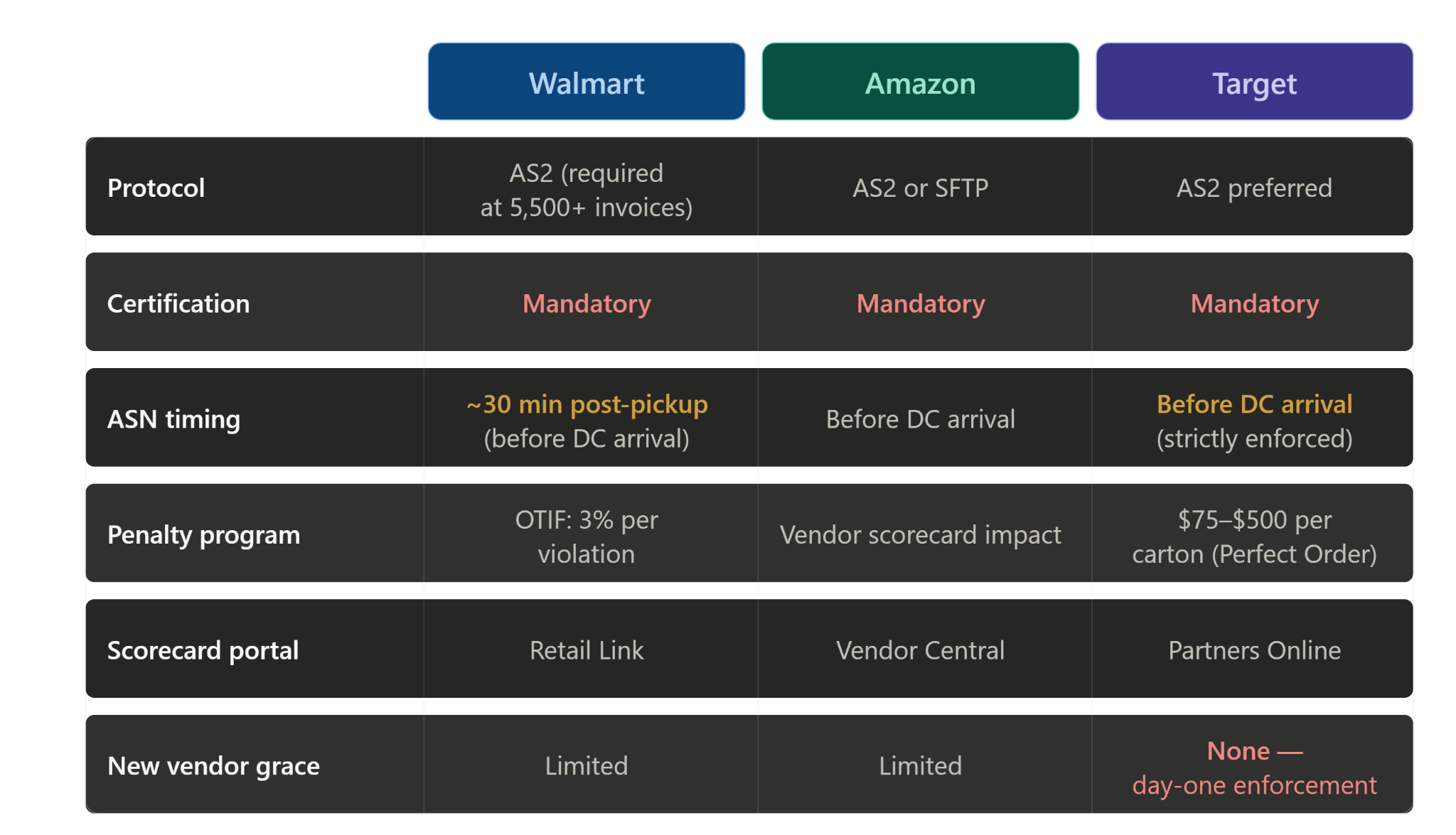
Suppliers processing more than 5,500 invoices per year must connect via AS2 (Applicability Statement 2), an application-layer protocol that requires a direct, secure endpoint configuration using HTTP/HTTPS, SHA-256 signed digital certificates, and a real-time acknowledgment loop called a Message Disposition Notification (MDN). When Walmart sends you a document, it expects a signed confirmation that the message was received and decrypted correctly before the transaction is considered successfully delivered at the transport level.
This is not the same as receiving a file over SFTP and parsing it. It requires infrastructure, not just software configuration.
Before a single live purchase order is processed, Walmart requires suppliers to complete a formal testing sequence. You work through defined test transactions, demonstrate that your system handles them correctly, and receive explicit sign-off. There is no informal go-live and no “clean it up in production.” Retailers have seen too many suppliers try that approach, and the trading partner setup approval requirement exists specifically to prevent it.
Walmart’s On-Time In-Full (OTIF) program automatically penalizes suppliers for shipments that are late or short. Deviations trigger chargebacks of typically around 3% of the cost of goods, depending on the program and violation type, which can quietly erode margins by 2-5% or more across a year of shipments without anyone flagging a single obvious incident.
The ASN is where most of these violations originate. Walmart expects the EDI 856 to be transmitted shortly after shipment departure and before arrival at the distribution center. An ASN that arrives after the physical goods is worse than a late ASN because the DC receiving team has no advance data to work with. Any mismatch between what the ASN says and what’s physically in the shipment, wrong carton count, wrong quantities, wrong SSCC numbers, triggers that are often processed automatically with minimal manual intervention.
Walmart requires suppliers to synchronize product data via GDSN as part of item setup and maintenance. This isn’t part of the EDI transaction flow, it’s a parallel data exchange requirement that suppliers often miss during onboarding because it shows up in a different part of the setup checklist.
For a deeper look at Walmart’s protocol requirements, see Aayu’s guide: Master Walmart AS2 and Amazon Mandates.
Target’s compliance model differs from Walmart’s in one important way: there is minimal tolerance for non-compliance after go-live. Where some retailers ease new vendors into their requirements, Target expects full compliance from the first live transaction. Getting the setup wrong in week one can result in chargebacks early, especially for critical issues (ASN, labeling, routing).
Target’s vendor portal is called Partners Online, and it’s active from the moment you go live. Every EDI document you send, every 855 acknowledgement, every 856 ASN, every 810 invoice, is tracked there. Compliance scorecards are updated regularly. Fill rate (units shipped vs. units ordered), on-time delivery rate, and ASN accuracy all feed into metrics that affect your standing as a vendor and, over time, can influence vendor performance standing and future opportunities.
Reviewing your Partners Online scorecard weekly isn’t optional maintenance. It’s how you catch problems before they escalate.
Target’s Perfect Order Program tracks fulfillment accuracy across the entire order lifecycle. When an ASN contains errors, the penalty isn’t a flat fee, penalties can be assessed per violation and, in some cases, scale with the number of affected cartons.
The most common trigger is an SSCC-18 mismatch. Every shipping carton you send to Target requires a unique SSCC-18 code (a Serial Shipping Container Code) that appears on the GS1-128 label physically attached to the carton. That same code must appear in the ASN data you transmit electronically. When Target’s DC scanner reads the label and the SSCC doesn’t match what the ASN says, the carton cannot be efficiently received and requires exception handling. At that point, you have a compliance violation, a receiving delay, and a chargeback often processed automatically with limited upfront notification.
Other common ASN errors that trigger Target chargebacks:
Target’s Routing Guide specifies approved carriers, appointment scheduling requirements, pallet specifications (typically 48x40 GMA pallets, with height limits that vary by DC, commonly around 48-60 inches), and carton standards. Missing a delivery appointment can trigger compliance deductions and rescheduling penalties. Using an unapproved carrier may result in freight rebilling plus additional compliance-related charges on top of a compliance fee. These aren’t edge cases, they’re common failures during the first few months of a new vendor relationship.
Amazon’s EDI compliance model is built around speed and acknowledgment integrity in a way that catches suppliers off guard if they’re used to more forgiving trading partners.
Every EDI document Amazon sends you typically requires a functional acknowledgment (EDI 997) within the timeframe defined by Amazon’s EDI requirements and the trading partner agreement. This isn’t just a courtesy confirmation that your system received the file. Amazon tracks FA compliance as its own metric, separately from whether the underlying transaction was correct.
The practical problem: many EDI systems process transactions asynchronously, meaning they queue documents and handle them in batches or on a schedule. That design works fine for plenty of integration problems. It doesn’t work well here, because any processing delay that pushes an acknowledgment past Amazon’s window is recorded as a compliance failure, even when the underlying transaction is eventually processed successfully. The compliance record reflects when the acknowledgment was received, not whether it eventually showed up.
Amazon monitors order-level fulfillment and delivery performance. Errors in product identifiers (SKU, UPC, GTIN), incorrect quantities, or shipment timing failures all feed into vendor scorecard metrics. A pattern of scorecard degradation can influence vendor performance evaluations and future business opportunities.
Invoices submitted via EDI 810 must reconcile against both the purchase order and the physical goods received. Quantity discrepancies, pricing mismatches, or missing PO references create payment holds that can take weeks to clear. Amazon’s invoice matching is automated, and invoices that fail automated validation typically enter an exception or dispute process rather than being approved automatically. If invoice data does not match expected values, the invoice may be rejected or placed on hold until resolved.
For a full breakdown of Amazon’s document requirements, see Aayu’s guide: Amazon EDI Requirements: A Complete Expert Guide for Suppliers.
It’s worth making this distinction explicit because it’s where a lot of technical teams underestimate the problem.
Building an integration that reads EDI documents and generates EDI documents solves a data formatting challenge. Retailers enforce a different set of requirements on top of that:
Most retail chargebacks across all three retailers trace back to a small number of recurring failure types. In order of frequency:

If you’re evaluating how to handle EDI for a major retail relationship or auditing your current setup, the question isn’t just “can our system generate the right documents?”
The more useful questions are:
For suppliers managing multiple retail relationships, the answer to these questions determines whether EDI stays in the background as infrastructure or becomes a recurring source of penalties and manual cleanup.
If there’s one document worth getting exactly right before you go live with any of these retailers, it’s the EDI 856.
The ASN tells the retailer what’s coming, how it’s packed, which cartons are on which pallets, and how each container is identified. When the DC receives your shipment, they’re scanning against that ASN data. If it matches, goods move into inventory efficiently. If it doesn’t, everything stops and the financial penalties follow automatically.
For a new vendor relationship with Walmart or Target, it’s worth running a physical dry run before the first live shipment: generate the ASN for a test shipment, print the labels, physically count the cartons against the ASN data, verify the SSCC codes match, confirm the timing window is achievable with your warehouse workflow. Problems caught before transmission cost nothing. Problems caught at the DC cost $75 to $500 per carton plus scorecard damage.
EDI compliance means meeting a retailer’s enforced rules for electronic document exchange: the required protocol (usually AS2), certification testing before go-live, ASN and acknowledgment timing windows, and data accuracy standards. It goes beyond being EDI capable, which only means your systems can read and generate the right file formats.
Late or missing ASNs are the most common cause across Walmart, Amazon and Target, followed by SSCC label mismatches, quantity variances, invoice errors and routing guide violations. Most trace back to the EDI 856 being transmitted late or not matching the physical shipment.
Walmart’s On-Time In-Full program typically charges around 3% of the cost of goods for shipments that arrive late or short, per Walmart’s supplier documentation. Penalties are applied automatically, so repeated small violations can quietly erode margins across a year of shipments.
No. Target expects full compliance from the first live transaction, and Partners Online tracks every document you send from day one. ASN, labeling and routing errors can trigger chargebacks in week one, which is why a physical dry run before your first shipment matters.
An SSCC-18 is an 18-digit Serial Shipping Container Code printed as a GS1-128 barcode on each carton and transmitted in your ASN. When the scanned label doesn’t match the ASN data, the carton can’t be auto-received, triggering exception handling and an automatic chargeback.
EDI compliance in 2026 isn’t about whether your systems can exchange the right file formats. It’s about whether your infrastructure can meet the protocol requirements, pass certification testing, handle timing-sensitive acknowledgments, adapt to spec changes, and surface exceptions before they become chargebacks, across retailers who have each built their own compliance programs with their own rules and their own penalty structures.
Suppliers who treat EDI as a solved problem after initial setup tend to discover that the penalties accumulate quietly. Suppliers who treat it as ongoing infrastructure, monitoring scorecard performance, reviewing ASN accuracy weekly, testing against updated specs, catching exceptions before they reach the DC, tend to maintain clean compliance records and avoid the kind of chargeback patterns that affect future order allocation.
The difference between those two outcomes is usually not technical capability. It’s whether someone is actually watching.
Managing retailer compliance manually is expensive, time-consuming, and risky, particularly once you’re operating across multiple retail relationships simultaneously.
With EDI Generator, your team can automate EDI transactions, validate ASNs before transmission, monitor document status, and stay ahead of retailer spec changes without building and maintaining a custom integration for each trading partner.
Ready to improve your retailer compliance process? Visit edigenerator.com to see how EDI Generator supports Walmart, Amazon, Target, and other major retail trading partners.
Contact us to see how Aayu Technologies can help you stay compliant with every trading partner.
Join hundreds of organizations already taking full control of their B2B AS2 communications with our trusted solutions. Contact us today to tailor a solution that fits your specific AS2 EDI needs.
Get full access to whichever product fits your needs. Configure real trading partner connections, run end-to-end transactions, and see the platform perform before making any commitment. All three products include a free 30-day trial with no restrictions.